This post contains affiliate links. We may earn a small commission when you buy through our links — at no extra cost to you.
Nobody packs the hospital gown. It arrives folded on the bed — thin, tied at the back, and cut for someone standing still rather than someone pacing a hallway in early labor with a monitor in each hand. A gown of your own covers your back, opens where the nurses need access, stays soft against skin that suddenly feels foreign, and still works at 3 a.m. when you’re nursing in the dark.
I’ve packed a hospital bag twice, and six months in 12 different gowns still taught me something. The closure is the part nobody researches and everybody regrets: velcro is fast for an epidural but rips through a quiet ward and snags in the wash, while snaps and buttons are quieter and need a hand you may not have free. Ignore the prints — check how far the back opens.
We wore these through third-trimester nights and the weeks after birth, in delivery rooms and on the couch at 2 a.m. The picks below split by who they suit: a hospital birth, a home birth, or a body the standard sizes ignore.


Best for Labor and Delivery
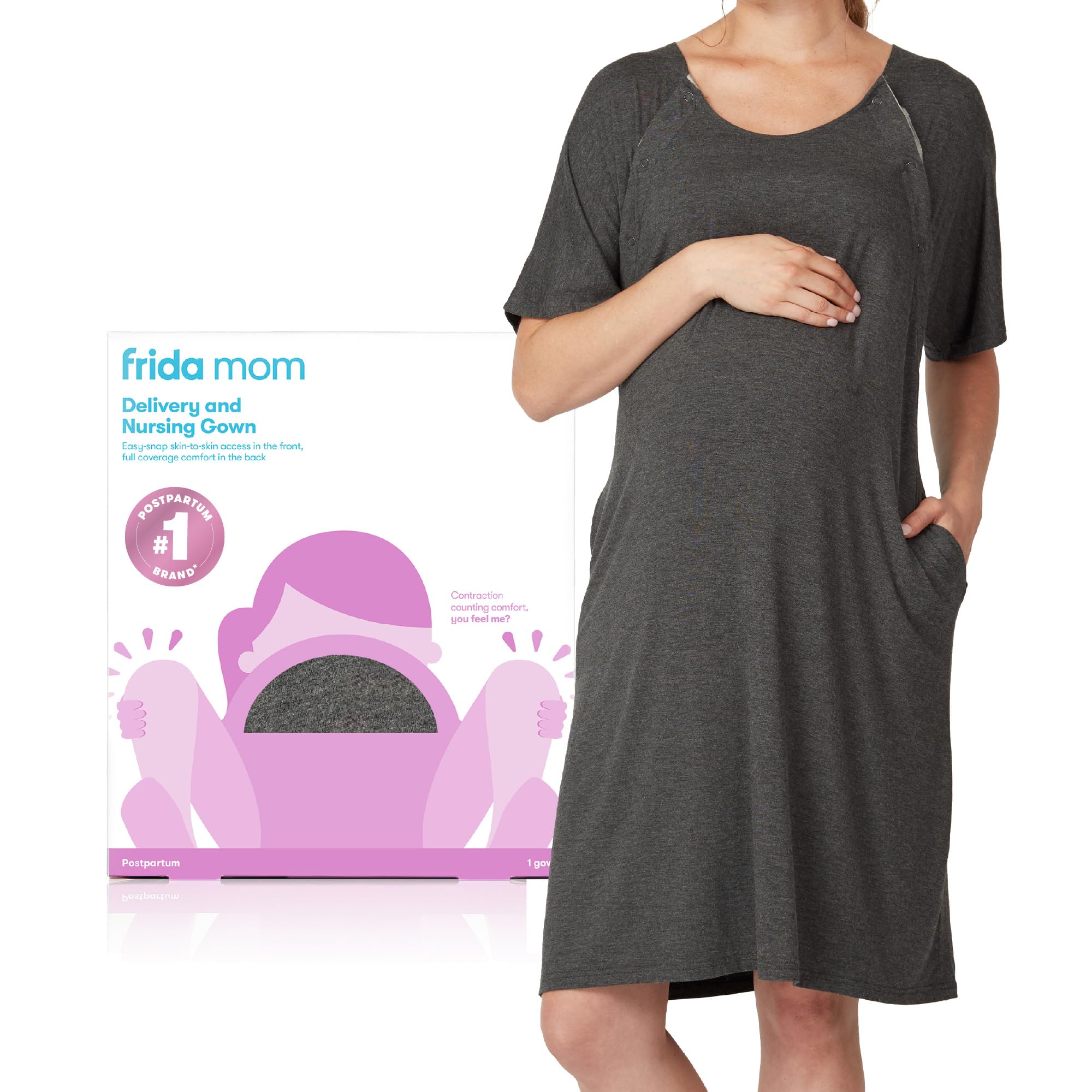
Frida Mom Labor and Delivery Gown
Key Features
- Fabric: 100% viscose, tagless
- Back access: Snaps from shoulder to back
- Front opening: Opens for nursing and skin-to-skin
- Price: Budget
A labor gown has one job before the baby arrives: let a nurse reach a monitor belt or your spine without a production. Frida Mom does it with snaps at the shoulders and down the back, so a section opens and closes while you stay where you are. It also costs the least of the gowns here, which makes it the easiest one to pack without debating the decision for a week.
The front opens on its own for nursing and skin-to-skin, and we like that the two openings are independent: a nurse working at your back does not uncover your chest. The fabric is 100% viscose and tagless at the neck, soft enough that we stopped thinking about it, and substantial enough to read opaque in daylight rather than clingy-transparent the way a hospital gown does. It wrinkles coming out of the bag and stays wrinkled, which stopped bothering us roughly an hour in.
Size is the one thing to think through. The gown is cut to drape rather than fit, and on smaller frames it swims, so if you are petite or were small before pregnancy, that is the detail to check before you order. Otherwise take your usual and let it hang; nobody will call this gown fitted, and at 3 a.m. that is the point.
Pros
- Snaps at shoulders and back for monitoring
- Front opens independently for nursing and skin-to-skin
- Lowest price of the gowns here
- Soft tagless viscose that reads opaque
Cons
- Wrinkles easily out of the bag
- Single gown only, no robe
The one we tell people to pack: shoulder and back snaps give nurses the access they need, the front opens for nursing, and it costs the least of the gowns here.
Best for Plus-Size Moms
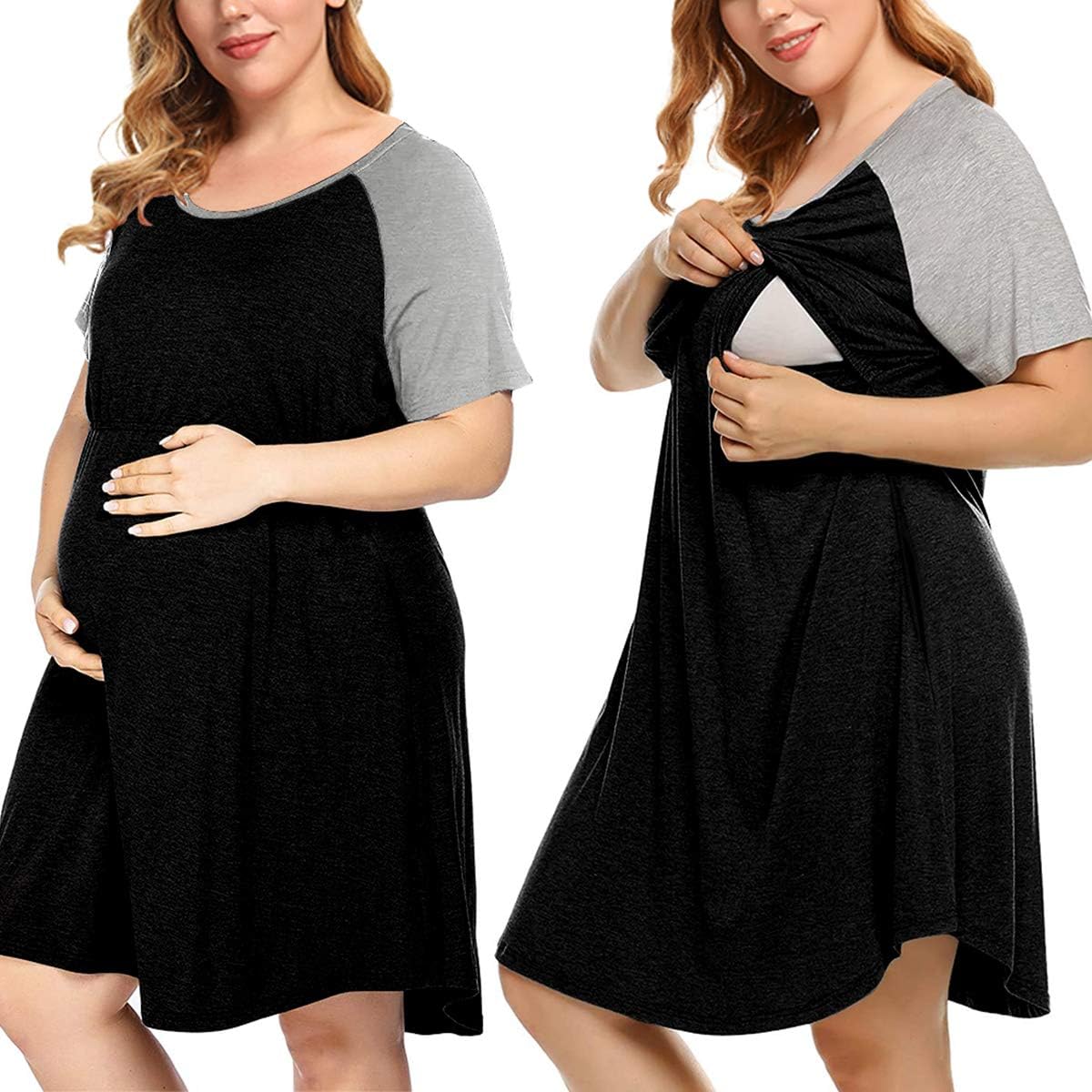
MONNURO Plus Size 3-in-1 Nightgown
Key Features
- Style: 3-in-1 labor, delivery, nursing
- Waist: Elastic waistline
- Pockets: Side pockets
- Size range: 1XL to 5XL
- Price: Midrange
The 1XL-to-5XL range is why this one is on the list. It is the only plus-size cut among our picks, and it handles the same 3-in-1 brief as everything else here: labor, delivery, and nursing afterward.
What we did not expect was how little it looks like a gown. The elastic waist and the side pockets push it toward house dress, which matters more than it sounds in the first weeks home, when the doorbell rings and you are not getting dressed for it. Of everything we tested, this is the one that stayed in rotation after the hospital bag was unpacked, and it runs true through the body with room to move.
Nursing access is simple enough to work one-handed at 4 a.m., and the stretch means it still fits over a 39-week belly and a deflated one a week later. The elastic waist is the detail we kept coming back to, because you can set it where it is comfortable, and after a C-section that is most of what you want from a gown.
Pros
- Plus sizes 1XL through 5XL
- Elastic waist and side pockets
- Reads as a house dress, not sleepwear
- Soft stretch fabric that fits late pregnancy and after
Cons
Start here if you are shopping in 1XL to 5XL: a soft, roomy gown with an elastic waist and pockets that looks like a house dress rather than sleepwear.
Best for Robe Coverage
Ekouaer Nursing Gown and Robe Set
Key Features
- Waist: Elastic waistline
- Front access: Split front flap
- Set includes: Gown and robe
- Price: Midrange
The robe is the piece that earns this set its place. It is what you throw on for the walk to the ice machine, over the gown or on its own when the gown is in the wash, and it is the difference between looking like a patient in the hallway and looking like a person.
Underneath, the gown has a split front flap that opens for nursing without undoing the whole thing, and an elastic waist that sits where you put it. The fabric is light and drapes instead of clinging, which is what you want on itchy third-trimester skin and on the sweaty postpartum nights when you are also managing a hospital pad. It hangs like a dress rather than bunching like a nightshirt, so the photos from the hallway are ones you will actually keep.
Nursing access is the strongest part of the design: the flap opens wide enough to feed without unpinning the rest of the gown, the fit runs true to size, and the robe falls to the knee. If you are deciding between this and a single gown, the question is what you plan to do in the hallway. The set covers it; a gown alone leaves you carrying a blanket.
Pros
- Robe doubles as a cover-up for walks
- Split front flap for nursing
- Soft, light fabric that drapes
- Elastic waist sits where you want it
Cons
- Fabric snags easily
- Dye can run, so wash it separately
Buy the set if you want the robe: it is what makes hallway walks and middle-of-the-night feeds easier, and the gown underneath is soft enough to sleep in.
Best for Monitored Labor
Kindred Bravely Universal Labor Gown
Key Features
- Access: Front and back open flat
- Closure: Velcro panels
- Pockets: Yes
- Price: Premium
Open one of these all the way and you get two flat panels, front and back, which is more access than any other gown on this list gives a nurse. A fetal monitor goes on through the gown, a contraction belt goes on through the gown, and an epidural does not require you to roll over and untie anything.
For a labor that is likely to be monitored, we think that is worth the premium. The panels hold hard, which is the point: a belt pulling on the gown does not pop it open by itself, and a fabric cover folds over the velcro for the wash so it does not grab everything in the drum. It is a design that assumes staff will be in and out of the room all night, and it behaves that way.
The rest is a normal nightgown: pockets, soft fabric, and enough room to wear it home from the hospital. Order your usual size rather than sizing up, because the cut is already generous through the body. It keeps working after discharge too, since the front opens one-handed for night feeds and nothing about it announces itself as medical wear.
Pros
- Full front and back opening
- Panels hold position under belts
- Pockets and a velcro wash cover
Cons
- Scratchy, bulky velcro against bare skin
- Cut a little short for taller frames
Choose this when you expect belts, checks, and an epidural: nothing else here opens as completely front and back, and that access is what the price buys.
Best for Postpartum Nursing
Soanhoo 3-in-1 Nursing Nightgown

Key Features
- Fit: True to size
- Style: 3-in-1 labor, delivery, nursing
- Front closure: Buttons
- Price: Midrange
There is nothing clever about this gown, and after a few days of hospital equipment that counts as a recommendation. It is a soft, long, button-front nightgown that happens to be cut for labor, and it is the one here most likely to end up in your regular pajama drawer once the baby is home.
We liked it most for the hours after delivery. It is cut longer than the hospital’s own gown, so you are not tugging it down every time you stand, and the knit stretches and breathes through a long night in a warm room. It runs true to size, and coverage is generous front and back, which matters when the door opens and it is not your nurse.
It is also the plainest of the group, with no robe, no velcro, and no hardware, and that is exactly why it wears so well at home: nothing to fasten, nothing scratchy against your skin, and a length that works as a nightgown instead of a costume. The front opens for feeds, though it is not the gown that lies completely flat for that first hour of skin-to-skin.
Pros
- Soft, breathable knit that stretches through labor
- Long enough to cover your legs standing up
- Doubles as an everyday nightgown afterward
Cons
- Front opening stops partway down
A soft, long, inexpensive gown that keeps working as a nightgown long after you are home, for the shopper who wants comfort more than hospital hardware.
How We Tested Labor and Delivery Gowns
We started with a list of roughly 40 gowns pulled from hospital-bag checklists, registry favorites, and reviews from people who had actually given birth in them, then cut anything that came in only one size, had a back that didn’t open past the waist, or cost more than a decent robe. Twelve made the cut, from budget to boutique.
Our testers ran from a small to a 3XL, including several who delivered by cesarean and one who gave birth at home. Every gown went into a hospital bag during the third trimester and was worn for at least six weeks: through triage, monitoring, and an epidural, through the days of rooming-in, and at home for the middle-of-the-night feeds. Testing overall ran about six months, since due dates don’t follow an editorial calendar.
We washed each one five times before the birth and noted whether the fabric pilled, stiffened, or shrank. In the delivery room we watched the closures under real conditions — whether velcro released with one tug or stuck to itself and pulled hair, whether snaps lined up with the monitor belts without undoing the whole gown, and whether buttons could be worked one-handed in the dark. Nursing access got timed with a baby in arms, pockets were judged on whether they held a phone through a hallway walk, and fit was rechecked at 38 weeks and again two days postpartum. We took photos in the hospital bed, because appearance matters when these become the pictures you keep, and asked each tester whether she’d pack it again instead of the free one.
How to Choose a Labor and Delivery Gown
The gown that works is the one that opens where the monitors go; everything else, from color to pockets, comes second.
Check How Far the Front Actually Opens
A gown can be sold as nursing-friendly and still stop at the sternum. That is fine for feeding a six-week-old and close to useless in the first hour, when you want fabric lying flat and a newborn on your chest. Look for closures that run from the shoulder to the waist, plus a back that opens on its own for monitor belts and an epidural.
Kindred Bravely opens completely on both sides; Frida Mom splits front from back, so a nurse can work at your spine without uncovering your chest. Ask yourself which of those two you need before you compare anything else.
Snaps, Velcro, or Buttons
Each closure has a personality. Velcro is the fastest one-handed option and holds its position under a monitor belt, but the panels are stiff and scratchy against bare skin and loud to rip open in a quiet room. Snaps are quieter and more secure, though they need two hands and can gap between fastenings. Buttons look most like clothing and are the slowest to work mid-contraction.
We put snaps first for a gown you will labor in for hours, and velcro first when access happens constantly. If you are planning an epidural, favor velcro and plan to wear a tank underneath.
Size for the Body You’ll Have Next Week
The common mistake is sizing up. These gowns are already cut loose, and the belly you are dressing for shrinks within days; you will wear the gown mostly postpartum, when a 39-week size hangs off you. Order from your current measurements, do not add a size for the bump, and take the smaller option when you are between sizes and petite.
The deliberate exception is the plus-size cut: MONNURO runs this gown from 1XL to 5XL, and its sizing lands true. If you are full-chested, check the bust measurement against the chart rather than the hip.
Fabric, Coverage, and the Walk Down the Hall
Delivery rooms run warm, and you will spend hours under a sheet with a cuff on one arm, so a light knit beats a heavy one. Light is not the same as thin, though: fabric you can see a hand through is fabric you will tug at the moment a visitor arrives. Knee length covers the walk to the nursery, and a robe, which the Ekouaer set includes, gives you something to pull on for the hallway.
Darker, saturated colors hide the postpartum mess better than pale grey. And treat the gown as a hospital nightgown you will keep wearing at home, because you will.
Frequently Asked Questions
Do I really need my own gown if the hospital provides one?
You do not need one, but the difference is bigger than it sounds. Hospital gowns are one size, open down the back, and get laundered for the next patient; a soft gown with front and back access keeps you covered while staff still reach everything they need.
Pack one and treat the hospital’s as backup. Policies vary, so call your unit at around 36 weeks and ask whether you can labor in your own gown with monitors on.
Can I wear my own gown during a C-section?
Usually not for the surgery itself. Hospitals typically require their own gown in the operating room, because it is standardized and made to work with surgical draping. That does not make yours pointless: it goes on afterward, for recovery and the days that follow, when IV and catheter access still matter.
Ask at your pre-op appointment so you pack the right thing instead of arguing it in the moment.
How many gowns should I pack?
Two, plus whatever you plan to wear home. One goes on for labor and will likely get messy; the second stays dry for after delivery, when you want something clean for visitors and photos.
If you buy a set with a robe, that robe covers the second layer for hallway walks, so two gowns and one robe is plenty.
What should I wear under a labor gown?
Nothing during labor if you can help it. Monitor belts and epidural access work best against the gown, and every pick here opens without you undressing.
After delivery, a nursing tank or a soft bra underneath adds coverage for visitors and speeds up feeds. It also keeps milk off a gown you may want to wear again the next night.
Final Verdict
The Frida Mom gown is the one to pack first. Its snaps handle monitors, epidural checks, and nursing, the fabric is soft and opaque, and it costs less than everything else on this list, which makes the decision easy for a purchase you may only use for a few days.
Spend up on the Kindred Bravely if you expect a monitored labor or an epidural, where full front-and-back velcro is the difference between a gown that works with the belts and one that fights them. Shopping in 1XL to 5XL, start with the MONNURO; it is the only plus-size cut here, and it keeps earning its place at home.
