This post contains affiliate links. We may earn a small commission when you buy through our links — at no extra cost to you.
Somewhere between the dairy case and the checkout line, every toddler decides they should be the one pushing. A toy shopping cart lets them run that errand at home, and it’s the rare pretend-play toy that earns its floor space — kids load it, unload it, ram it into the sofa, and come back for more. The catch is that a cart with stiff casters or a handle at a 3-year-old’s chin gets abandoned within a week.
I’ve spent the past five months with a dozen of these, and the favorites share a few traits: wheels that actually steer, a frame that stays upright when a kid piles it with blocks and then leans on the handle, and a look that doesn’t make you wince when it’s parked in the living room. Handle height matters more than most shoppers expect; too tall tips forward on the push, too short turns the whole thing into a kneeler.
The picks below cover both ends of that range, from first-birthday push toys to taller carts a 5-year-old can still steer.


Best for Everyday Pretend Play
Melissa & Doug Toy Shopping Cart
Key Features
- Frame: Metal
- Weight: 11.1 lb
- Recommended age: 3+ years
- Assembled dimensions: 14.5 x 15.75 x 20.75 in
- Price: Midrange
Lifting this cart out of the box tells you most of what you need to know: 11.1 pounds of welded metal frame and basket, closer to the cart your child rides in at the supermarket than anything else in this group. Melissa & Doug rates it for ages 3 and up, and nothing about it is babyish. That pairing of real materials and realistic size is exactly why it ends up at the top of this list.
The front wheels pivot and the rear pair do not, which is how a real cart steers. In a kitchen with an island to circle, that matters more than any other feature here: a child pushes, turns, and keeps going instead of skidding sideways or stopping to lift the front end. The seat under the handle folds open for a doll or a stuffed animal, and the basket is deep enough for a genuine haul of play groceries.
There is real mass here, and we came to see it as the feature rather than the cost. The cart stays planted when a toddler leans hard on the handle or pulls up on the side, so play does not end with a tip-over. On a thick rug, a young 3-year-old may need a hand to get it rolling again, which is the trade for a cart that does not go over.
Assembly is a handful of bolts and the four wheels, and the frame is rigid once they are tight, which is the advantage of metal over a snap-together plastic body. The fold-flat doll seat gets more use than the basket in our experience: it turns the cart into a stroller for a stuffed animal the moment the groceries come out.
Pros
- Metal frame feels like a store cart
- Pivoting front wheels steer around corners
- Fold-open seat carries a doll
- Quick assembly, rigid once tightened
Cons
- Metal frame can scuff walls and baseboards
Our top pick for good reason: a metal frame that survives rough play, pivoting front wheels that actually steer, and a doll seat for the passenger. Buy it for a 3- to 5-year-old.
Best for Budget First Cart
Little Tikes Shopping Cart
Key Features
- Weight: 7.2 lb
- Material: Plastic
- Recommended age: 24 months to 5 years
- Assembled dimensions: 22 x 15.88 x 9.5 in
- Price: Budget
This is the least expensive cart we recommend, and the one to put in front of a 2-year-old who is still rough on toys. It is plastic, it weighs 7.2 pounds, and the maker rates it from 24 months to 5 years, so it covers the years when a cart gets shoved, sat in, and dragged down a hallway by one handle.
Stability is what settles it for us. The base is broad and sits low, so the cart resists tipping when a toddler leans hard on the handle or backs into a wall, which is the failure that ends playtime with a lot of first carts. For a child still working out balance, we put that above almost everything else.
The wheels are the compromise. All four are fixed, so the cart tracks straight and true down a hallway but has to be lifted or dragged around a corner, and on carpet it plows more than it rolls. The handle also sits high for the youngest end of the range; at 18 months a small child is reaching up to push, and the fit gets better around age 2.
Cleanup is where it surprised us. The basket has real walls that keep small pieces from spilling out at every turn, and the shelf underneath catches whatever did not make it in, so the play food and the doll end up in one place instead of across the living room.
Pros
- Wide, low base resists tipping
- Deep basket keeps small pieces contained
- Storage shelf under the basket
- Least expensive cart here
Cons
- Wheels do not swivel, so steering takes two hands
- Handle sits high for children under 2
We recommend the Little Tikes cart to anyone buying a first cart for a rough 2-year-old: it pushes easily, resists tipping, and takes being climbed on.
Best for Small Playrooms
Step2 Little Helper’s Shopping Cart
Key Features
- Weight: 4.9 lb
- Doll seat: Included
- Recommended age: 24 months to 5 years
- Assembled dimensions: 18.5 x 13 x 21.5 in
- Price: Midrange
Set this cart beside our top pick and the first difference is weight: 4.9 pounds against 11.1. A 2-year-old can shove the Step2 across a room one-handed, and an adult can move it out of the way with a toe at bedtime. In a small apartment or a playroom that has to be reclaimed every evening, that gap is the whole argument.
The body is double-walled plastic, which is why it takes being climbed on and wipes clean with a household wipe after a snack spill. We like the play grocery cart that body produces: a generous basket that swallows a 15-inch doll with room left for pretend food, and a doll seat at the front that keeps a passenger upright.
What it does not include is food. The cart ships on its own, so the pretend groceries are a second purchase, and the plastic body does not have the heft or the supermarket look of the metal cart. That is a fair trade if you are buying for the weight and the wipe-down. Assembly needs an adult and the included hardware, and everything you need is in the box.
Pros
- Light enough for a toddler to push one-handed
- Double-walled plastic wipes clean
- Generous basket fits a 15-inch doll
- Doll seat included at the front
Cons
- Play food sold separately
- Plastic body lacks the metal cart’s realism
For a small playroom and quick cleanup, this is the cart we send shoppers to: light, stable, and wipe-clean, though the play groceries cost extra.
Best for New Walkers
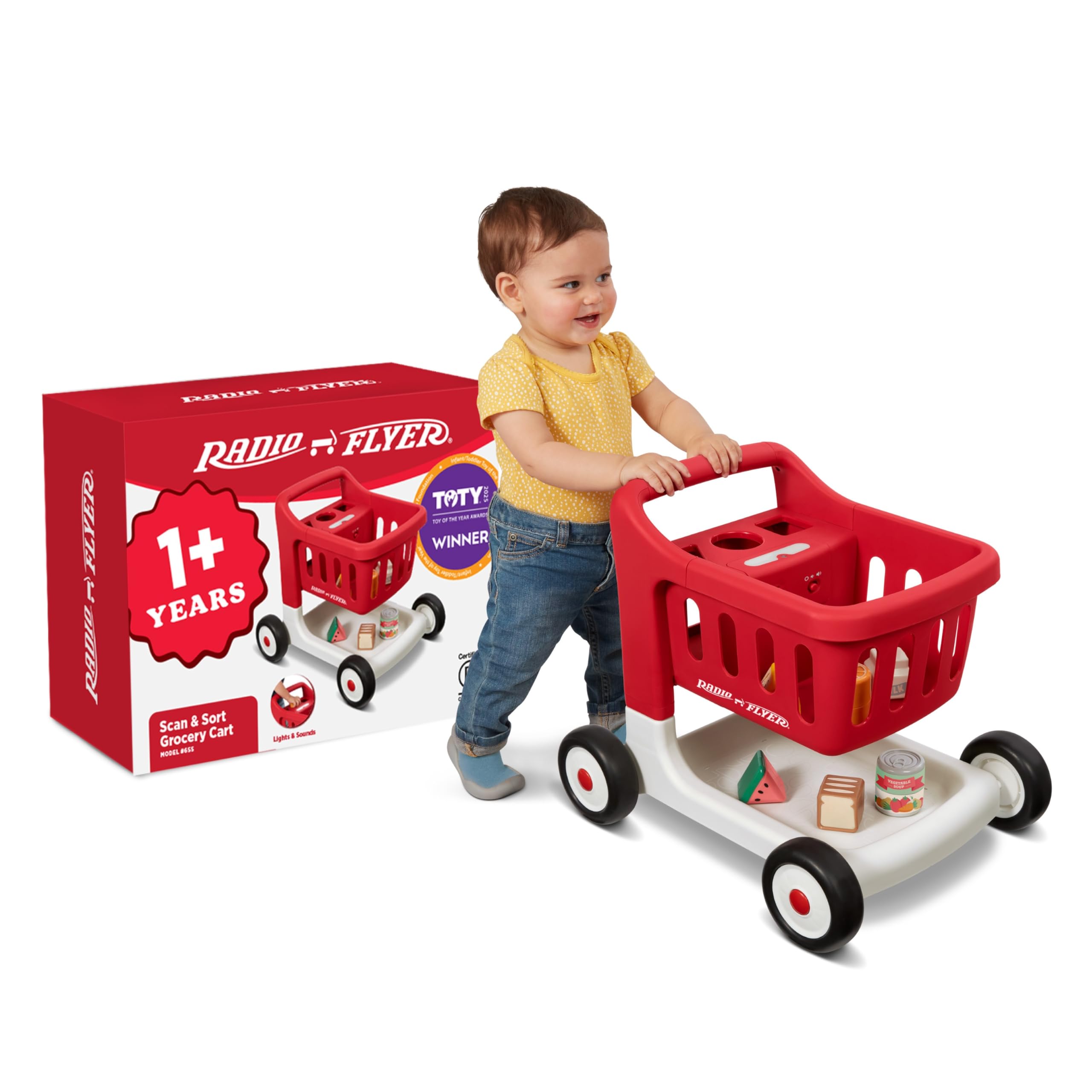
Radio Flyer Scan & Sort Shopping Cart
Key Features
- Weight: 5.8 lb
- Included: 6 play food pieces
- Recommended age: 12 months to 6 years
- Handle positions: Three heights
- Price: Premium
Twelve months is the number that matters here. This is the only cart in the group built for a child who is still cruising the couch, and Radio Flyer designed it that way: resistance clickers in the wheels that hold the cart back to a new walker’s pace, and three handle heights that move up as the child grows.
The scanner is what kids come back for. Run a play food piece past it and the cart lights up and announces the item, and the six included pieces double as shapes for the sorting cutouts on top of the basket. Batteries come in the box, and the volume adjusts, which matters more to the adult in the room than to the child.
Where this cart argues with itself is the rolling. The wheels track in one direction, so a tight turn means stopping and resetting, and on hardwood the cart can outrun a brand-new walker even with the resistance working. On carpet it behaves nicely. For the first few weeks, plan to stay within arm’s reach.
Once the walking is sorted, the pretend side is thinner than our top pick’s: no doll seat, no lower shelf, and the shopping is mostly scanning and sorting. The handle keeps growing, though, which keeps it in rotation long after the first steps are history.
Pros
- Rated from 12 months for new walkers
- Three adjustable handle heights
- Resistance clickers slow the cart
- Scanner lights, sounds, and shape sorter
Cons
- Wheels track in one direction only
- Highest price in this group
Buy the Radio Flyer for a 1-year-old who is pulling up and cruising: three handle heights, movement resistance, and a scanner that gives them a reason to keep pushing.
How We Chose and Tested Toy Shopping Carts
We started with every kids’ shopping cart sold by the major toy brands, then read the specs and customer reviews and cut anything without a stated age range, a visible wheel design, or a handle height that made sense for a toddler. That left 12 carts — a mix of plastic and metal, small push toys and taller frames — and we deliberately kept the price range wide rather than testing only the expensive ones.
Kids from 1 to 5 pushed them through the kitchen during dinner prep, down the driveway, around a grandparent’s living room, and on a couple of real grocery runs with a parent. We watched which carts got picked up again the next morning and which ones sat in the corner; one that got ignored by week two didn’t make the list, no matter how well it was built.
Each cart was loaded with a 5-pound bag of flour and a pile of blocks, then pushed over a rug edge and a door threshold, so we could see which ones tipped, which skidded, and which turned without a fight. We measured every handle against each kid’s standing height, timed assembly out of the box, and checked for wheel wobble after five months of daily use. We also wiped each one with a damp cloth after a week of snack crumbs to see how the finish held up, and asked at the end whether it felt worth the money.
How to Choose a Toy Shopping Cart
The right cart comes down to two things: how steady your child is on their feet, and where the cart will actually be pushed.
Start With the Walking Stage, Not the Birthday
Age ratings across these carts run from 12 months to 3 years, and the gap is about balance rather than maturity. A child still cruising needs a cart that resists rolling away and a handle they can reach without stretching; the Radio Flyer’s three handle positions and its movement resistance exist for exactly that stage. A confident 3-year-old wants the opposite: a heavier cart that steers and looks like the one at the store.
The trap is buying the realistic metal cart for a 1-year-old. At 11.1 pounds it can move faster than new feet can follow, and a toddler who has to chase it loses interest fast. Set the handle against the child’s chest, not their shoulder, before you commit.
Pivoting Wheels vs. Fixed Wheels
Front casters that pivot are the difference between a cart a child can steer and one they have to lift around a corner. Our top pick turns on pivoting front wheels; the Little Tikes cart runs on four fixed wheels, which track straight and true down a hallway but need a two-handed reset at the end of it.
Where the cart will live decides this. A tight kitchen with an island, or a playroom full of furniture, is worth paying for swivels. A carpeted room where the cart mostly goes forward is fine on fixed wheels, which drag less than you would expect on pile.
Metal or Plastic
Metal frames read as real and shrug off years of shoving; the Melissa & Doug cart is the only metal one we recommend, and its 11.1 pounds are the price of that solidity. Plastic is lighter, quieter against baseboards, and wipes clean — the Step2 and Little Tikes carts both come in under 8 pounds.
Think about your walls and floors too. A metal basket swung into a door frame leaves a mark, and a heavy cart on hardwood is louder than a plastic one. If the cart will be indoors in a small space, plastic is the easier housemate.
Basket, Doll Seat, and What’s in the Box
Decide up front whether you want a passenger. The Melissa & Doug and Step2 carts both have a fold-down doll seat; the Radio Flyer trades that for a scanner and a shape sorter. Deep baskets with real walls keep small groceries contained, and a shelf underneath catches whatever did not make it in.
Then check the box contents. A play grocery cart that ships with food saves you a second purchase, and most of these do not include any. Cardboard food boxes crush under a toddler in a week; plastic pieces survive being stepped on.
Measure Where It Will Park
These carts run roughly 18 to 22 inches wide and 13 to 16 inches deep, so they claim a corner of a playroom or the end of a hallway rather than a shelf. Measure the parking spot and the doorway it has to pass through; none of these fold flat.
If the cart has to disappear between play sessions, plan for closet floor space and pick the lightest option you can. The Step2 is the easiest of the group to move one-handed at 4.9 pounds, while the metal cart is a two-hand lift for an adult.
Frequently Asked Questions
Can a toy shopping cart go outside?
Plastic handles a driveway or patio far better than metal. The Little Tikes cart is rated for indoor and outdoor use, and a wipe-down takes care of dust and crumbs. Keep a metal cart like the Melissa & Doug inside, where the frame stays dry and the wheels stay clean.
Either way, check the wheels after outdoor play. Grit in the casters is what turns a cart that rolled smoothly into one that drags and pulls to the side.
How much assembly is involved?
All four carts arrive partly disassembled, and every one needs an adult with a screwdriver; none of them come out of the box ready to push. The Little Tikes cart has the most pieces, so open that box a day or two before a birthday rather than the morning of.
The Melissa & Doug cart goes together with a handful of bolts and its four wheels, and the Step2 ships with the hardware it needs. Tighten everything before the first play session.
Will a toy shopping cart fit in the car?
None of these collapse, but all of them stand about two feet tall or less, so one fits in a trunk or behind a front seat without much fuss. They are too big for a stroller basket, so plan to carry the cart separately on a trip to the store.
If you will be lifting it in and out often, weight matters more than dimensions: the Step2 is the lightest here at 4.9 pounds, and the metal Melissa & Doug cart is the heaviest at 11.1.
Final Verdict
The Melissa & Doug Toy Shopping Cart is the one we point most families to. The metal frame survives being leaned on, the pivoting front wheels let a child actually steer around furniture, and the fold-open doll seat gives a stuffed animal a ride. Buy it for a 3-year-old and up who wants the cart they see at the store.
If the child is still cruising, start with the Radio Flyer instead; its resistance wheels and three handle heights are built for that stage. And if floor space is tight, the Step2 gives you a stable, wipe-clean cart at less than half the weight.
