This post contains affiliate links. We may earn a small commission when you buy through our links — at no extra cost to you.
Few numbers matter more in the first year than the one the nurse reads off the pediatrician’s scale. Between checkups the tracking falls to you, and stepping on a bathroom scale with a baby in your arms tells you almost nothing. A baby scale closes that gap: a stable little platform that reads in pounds and ounces and holds the number while your baby squirms.
My team and I spent the past six months living with 10 of them, from the first week home through the toddler months when standing still becomes a negotiation. The good ones share a few things: a tray deep enough that a newborn doesn’t feel like rolling off, a hold function that locks instead of flickering, and a footprint that doesn’t swallow the dresser. Accuracy is the headline, but accuracy you can’t repeat is useless — a scale that drifts a few ounces between back-to-back weigh-ins will have you second-guessing every reading.
Capacity is the other thing to check before you buy: several of these top out around 44 pounds and are really newborn-and-toddler tools, while a few go past 60 or well beyond and can follow a kid, or the cat, into preschool. The picks below are the ones we’d clear space for again.


Best for Newborns to Toddlers
Salter Digital Baby & Toddler Scale
Key Features
- Tray: 21.5 x 10 in, removable
- Capacity: 44 lb
- Hold and tare: Both
- Readout increment: 1/2 ounce
- Price: Premium
A baby scale earns trust in about ten seconds, and this one earns it by refusing to move. The base is heavy, the footprint is wide, and the whole thing sits on a dresser like a piece of office equipment rather than perching on an edge. Set a squirming newborn on it and it stays exactly where you put it, which is the first thing we check and the thing most home scales get wrong.
The tray is what keeps us coming back to it. It’s a 21.5-by-10-inch scoop with real sides, deep enough that a newborn settles into it instead of balancing on a flat plate, and it lifts off in one piece so an older child can stand on the platform underneath. That conversion is what makes 44 pounds worth paying for: the same instrument weighs a newborn in half ounces and a four-year-old in pounds.
Zero and hold both behave. We put a folded blanket in the scoop, tared it, and got back to zero in one press; hold locks a weight while legs are kicking and leaves it on screen after you lift the baby off. The trade-off is resolution — half-ounce steps, about 14 grams, where several scales here read to a tenth of an ounce. For week-to-week growth that’s plenty. For weighing before and after a feed, it’s blunt.
It’s also the most expensive scale in this group, with no app, no height ruler, and no Bluetooth, and we didn’t miss any of it. If you want ounce-level deltas charted for you, the Greater Goods Smart does that. If one scale has to serve the whole household, the GROWNSY goes to 330 pounds. Neither of them feels this planted under a wiggling baby.
Pros
- Heavy base that stays put
- Deep scoop cradles a newborn
- Tray lifts off for toddler weighing
- Hold and zero respond on one press
Cons
- Heavy and bulky to store
- Runs on a 9-volt battery
The scale we trust for a number worth acting on: a heavy base and a deep scoop hold a newborn steady, and the tray comes off when they start standing.
Best for Growth Chart Tracking
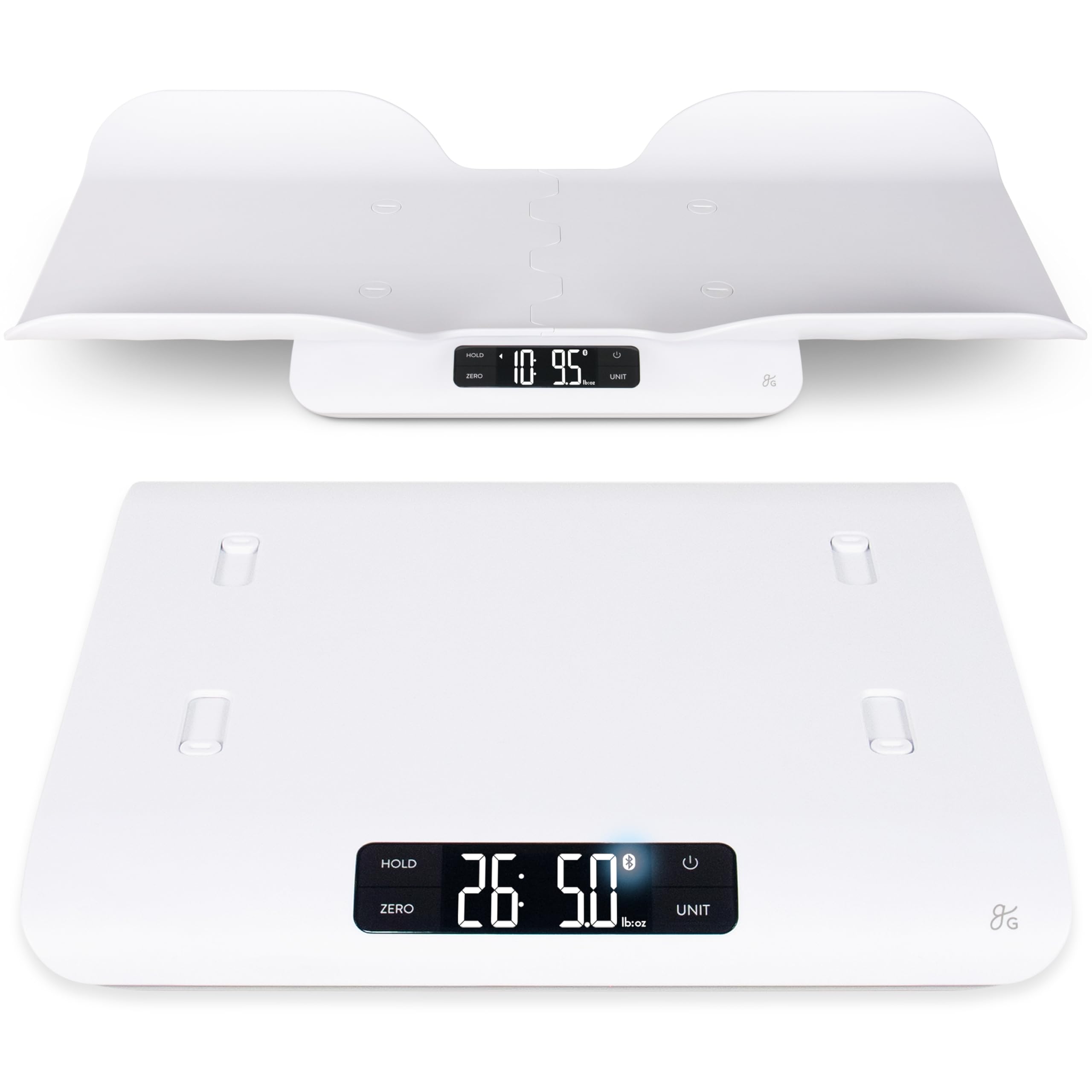
Greater Goods Smart Baby Scale
Key Features
- App: Bluetooth growth tracking
- Tray: 24 x 11.5 in, removable
- Capacity: 66 lb
- Readout increment: 0.1 ounce under 18 lb
- Price: Midrange
The reason to buy this one isn’t the scale, it’s the chart. The Greater Goods app logs each weigh-in and plots it with a percentile, so whether she’s gaining enough becomes a line on your phone instead of a page of numbers in a notebook. Weigh the baby, step back, and it’s already there — as long as your phone is within range and paired, because the transfer happens at the scale rather than the next time you open the app.
Underneath the software is a solid 66-pound two-in-one. The 24-by-11.5-inch tray gives a newborn room to stretch out, then comes off so a bigger child can stand on the base, and under 18 pounds it reads in 0.1-ounce steps — fine enough to see a couple of days of growth. Hold is the feature we leaned on most: it waits for a stable number and locks it, so you can pick the baby up and read the display with both hands free.
Two things to plan for. It wants a firm, level surface; on a changing pad or a rug the numbers drift and you’ll blame the scale. And the tray is a separate piece that has to be seated properly before you trust a reading. Neither is unusual for the category, but this is a scale you set up once in a dedicated spot rather than carry around the house.
Length goes into the app by hand rather than off markings on the tray, which is the easier half of the job anyway. Two years from now, the percentile curve is the thing you’ll still be looking at.
Pros
- Weigh-ins log themselves in the app
- Percentile chart builds as you go
- 0.1-ounce readings under 18 pounds
- Removable tray converts to a stand-on scale
Cons
- Tracking depends on a paired phone
The pick for anyone who wants the growth curve handled: every weigh-in lands in the app, and the tray comes off when your toddler graduates to standing.
Best for Babies and Pets
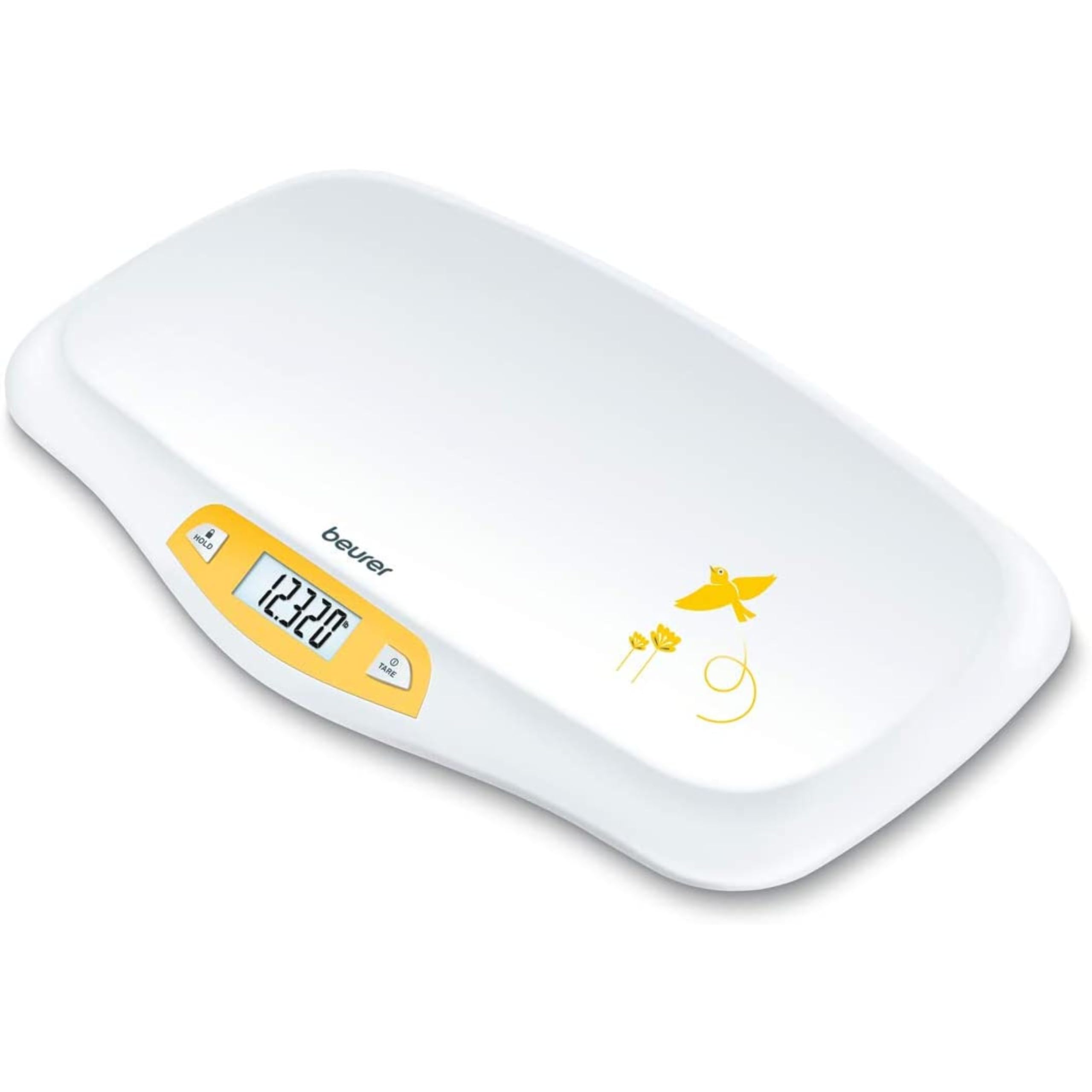
Beurer BY80 Digital Baby Scale
Key Features
- Hold: Automatic and manual
- Capacity: 44 lb
- Warranty: 5 years
- Readout accuracy: 0.2 oz
- Price: Budget
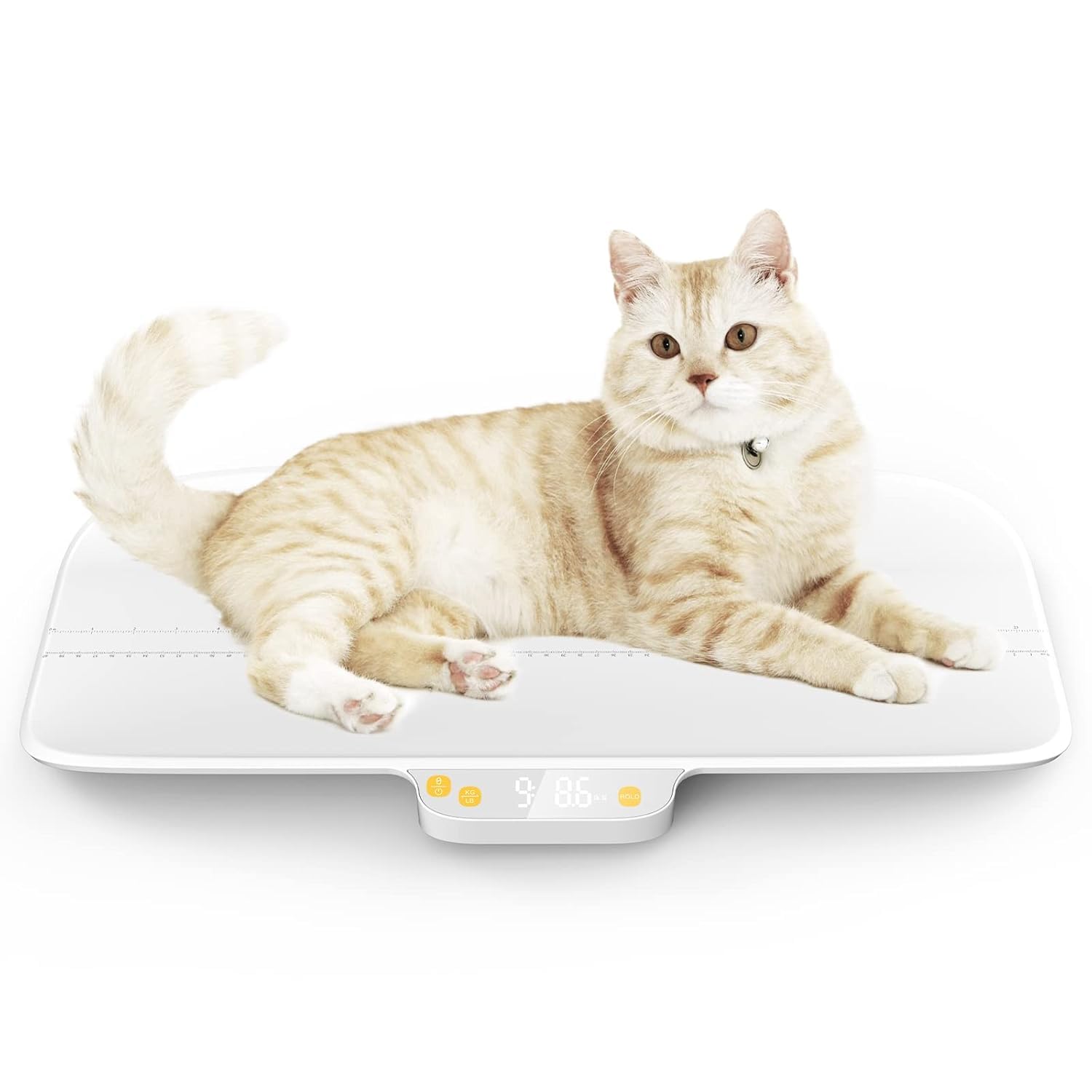
Half the baby scales sold end up weighing something else, and the Beurer is built for that second life. The platform is a shallow oval with no hard edge anywhere on it, so a newborn, a cat, or a small dog all get the same smooth surface — and the 44-pound ceiling means it also handles a kindergartner.
Two buttons do most of the work. Hold takes a stable reading automatically or when you press it, tare zeroes out a blanket, and the backlight means a middle-of-the-night weigh-in doesn’t require the nursery lights. It reads in pounds, ounces, or kilograms on a display you can see from standing height, and at just over four pounds it moves from nursery to bathroom without ceremony.
Where it gives ground is movement. The oval is comfortable but shallow, and a baby who arches or kicks can push the reading around; we wait for the lock and take a second reading rather than trusting the first number that appears. At the lower end of the prices here, with a five-year warranty behind it, that’s a fair trade for a household that wants one device for the baby and the animals.
The seamless platform wipes clean with a damp cloth — no seam for milk or spit-up to collect in, which matters more than it sounds in the first six months.
Pros
- Edge-free oval suits babies and pets
- Tare zeroes a blanket in one press
- Backlit display for night weigh-ins
- Five-year warranty
Cons
- 44-pound limit is outgrown by school age
A sensible first scale for a house with pets: the smooth, edge-free oval suits a baby or a cat, and the five-year warranty covers the years you’ll use it.
Best for Whole Family
GROWNSY Digital Baby & Pet Scale
Key Features
- Tray: Detachable
- Capacity: 330 lb
- Weighing units: 5
- Height measurement: 27 inches
- Price: Budget
Three hundred and thirty pounds is an absurd number for a baby scale until you see what it buys. This is the one here that stops being a baby scale: the tray detaches, the platform underneath takes an adult, and a 27-inch height measurement is built in. One device covers a newborn check, a toddler’s growth spurt, and your own weight on a Sunday morning.
That flexibility is the reason to choose it, and the baby half doesn’t suffer for it. The tray is long enough for a newborn to lie flat, hold takes a reading through the fussing, and the display cycles through five units including pounds-and-ounces, which is how the pediatrician’s numbers arrive. The height measurement is the sleeper feature — you’ll use it at every well-visit prep and never think about it otherwise.
It’s plastic and light at about four pounds, and the touch buttons want a firm press rather than a tap. We found it settled fastest on a hard, flat surface; on anything softer the display chased the baby’s movement. Weigh twice when the first number looks wrong — this is a scale that rewards a second attempt more than most.
Pros
- Weighs up to 330 pounds
- Detachable tray becomes a floor scale
- Built-in 27-inch height measurement
- Five weighing units including lb:oz
Cons
- Touch buttons need a deliberate press
- Plastic body feels light next to the Salter
Buy it when the scale has to serve the whole house: it weighs a newborn in ounces, an adult in pounds, and doesn’t cost much more than a baby-only model.
Best for No-Assembly Setup
MINDPET-MED Digital Pet & Baby Scale
Key Features
- Assembly: None required
- Capacity: 66 lb
- Precision: 0.08oz (2g)
- Item weight: 3 lb
- Price: Budget
There is nothing to put together here. Tray and scale are one molded piece, so there’s no clip to line up, no tray to reseat after a toddler knocks it, and no joint for a wiggly baby to work loose. It comes out of the box, takes batteries, and reads.
What it does better than anything else in this group is resolve small changes: 2 grams, about 0.08 ounce, the finest step on this page. For a newborn gaining an ounce a day, or a kitten being tracked by the gram, that’s the difference between a trend and a guess.
The trade-off is mass. At three pounds it’s the lightest scale here, and a light scale on a soft surface is a scale that moves; we keep ours on a hard counter with a hand on the baby, and it settles quickly. If you plan to weigh on a rug or a bed, one of the heavier scoops — the Salter especially — will behave better.
The 66-pound ceiling covers the baby years and then some, and tare is one press away, so a folded towel or a diaper doesn’t have to be subtracted by hand. Storage is the quiet win: one piece means one thing to find a home for, with no tray living separately in a closet.
Pros
- Finest resolution here at 2 grams
- No assembly and no tray joint
- Quick tare for a towel or blanket
- Three-pound body stores easily
Cons
- One-piece body can’t convert to a stand-on scale
The no-assembly pick: one molded piece, the finest resolution here, and a light body that wants a hard, flat surface under it.
Best for Budget Height Tracking
MomMed Baby Scale BS-01

Key Features
- Capacity: 220.5 lb
- Batteries: 2 AAA included
- Tray lock: Two swivel locks
- Height measurement: In the tray
- Price: Budget
This is the least expensive scale here that includes a height ruler, and that pairing is why it turns up in so many nurseries. For a budget price you get pounds, ounces, or kilograms on a bright backlit display, hold and zero, and a top tray that lifts off so the base can weigh a standing child.
Setup takes minutes. Two swivel locks under the tray twist to hold it on, the whole thing comes apart again for storage, and the height markings inside the tray let you log length in the same session as weight. Two AAA batteries come in the box, which is a small kindness on discharge day.
Readings want a still baby on a hard floor, and the display dims quickly once you step off, so we read the number on the way up rather than after. It goes to 100 kilograms, which means nobody in the house outgrows it.
What it isn’t is a precision instrument for ounce-level detective work. Track weekly and it does the job; weigh before and after every feed and you’ll want one of the finer scales above.
Pros
- Least expensive scale here
- Height markings built into the tray
- Tray locks on with two swivels
- Batteries included
Cons
- Tray must be locked on before each use
- Plastic body feels light for the price
The budget pick that also measures length: weight and height in one session, at a price that leaves room for the diaper fund.
Best for Whole-House Weighing
TIPRE Baby Weight Scale CS03

Key Features
- Tray: Detachable
- Display: Auto-rotating LED
- Capacity: 400 lb
- Increments: 0.01 lb/5 g
- Price: Budget
The display on this one turns itself around. Stand on the platform and the LED swings the numbers toward you; set the baby tray on top and they face the other way. It’s a small piece of theater that turns out to be genuinely useful — you’re never crouched at eye level with an upside-down readout.
Capacity is the other headline: 400 pounds, well past any child, so this replaces the bathroom scale rather than sitting beside it. The tray lifts off and the base underneath is a normal step-on scale with increments of 0.01 lb/5 g and a tare key for a blanket or a pet carrier. We weighed adults on it as readily as the baby.
Two touch keys run everything, the feet are non-slip, and the whole thing is light enough to move between rooms. What it doesn’t have is mass or patience: it’s very sensitive to a moving baby, and the display chases a squirm instead of settling on a number. Weigh twice, and put it somewhere solid.
Where it earns its place is as the family scale that happens to do babies. If the idea of a single-purpose object that’s obsolete in three years bothers you, this one keeps working long after the tray goes in a closet — and it’s one of the cheapest ways here to cover everyone in the house.
Pros
- Rotating readout visible from either position
- 400-pound capacity covers the whole family
- Detachable tray for step-on weighing
- 5-gram (0.01-pound) increments
Cons
- Tray has no dedicated storage spot
- Light body shifts on a soft surface
For a household that wants one scale for everyone: 400 pounds of capacity, a detachable baby tray, and a readout that turns to meet your eyes.
Best for Weight Plus Length
RAOYAN Baby Scale with Tape

Key Features
- Tray: 21.6 x 12.6 in concave
- Capacity: 88 lb
- Measuring tape: 60-inch, built-in
- Readout increment: 0.1 oz
- Price: Budget
There’s a 60-inch retractable tape measure built into this tray, which sounds like a gimmick until you’re the parent trying to remember whether the two-month visit measured 22 inches or 23. Weight and length get logged in the same thirty seconds, and nothing else in this guide does both without a separate ruler. We ended up using it at every weigh-in without thinking about it.
The rest of the design aims at the same job. The tray is 21.6 by 12.6 inches with a concave floor, so a newborn settles into the dip instead of sliding toward an edge, and the display reads in five units including pounds-and-ounces. At 88 pounds with 0.1-ounce increments, it holds a useful resolution through the newborn months and still has room for a second-grader.
Auto hold and tare work the way you want: zero the blanket, lay the baby down, wait for the lock, read it after you lift them off. Because the increment is fine, the surface matters — 5 grams is a small enough step that a rug will show up in the number.
This is the pick for a parent who wants the length column filled in as carefully as the weight column, and who doesn’t need the scale to become an adult scale afterward. The 88-pound ceiling is the honest limit: it sees a child through elementary school and stops there.
Pros
- 60-inch tape measure built into the tray
- 0.1-ounce increments
- Deep concave tray keeps a newborn centered
- Reads in pounds-and-ounces
Cons
- 88-pound ceiling rules out adult use
The one to get when length matters as much as weight: a tape measure built into the tray and a deep scoop that keeps a newborn centered.
How We Chose and Tested These Baby Scales
We started by pulling every scale we could find that read in tenth-of-an-ounce increments and held at least 44 pounds, then whittled the field down by capacity, tray depth, hold and tare functions, and price until we had 10 worth bringing home. Each one lived in a real nursery for six months, on a dresser beside the wipes, used the way parents actually use them: first thing in the morning before a feed, after a bath, and once a week just to see.
Accuracy came first. Every scale got a 10-pound reference weight placed dead center, then near each corner, and we logged whether the reading held or wandered. We compared morning weigh-ins against the pediatrician’s calibrated scale at the next checkup and weighed the same baby twice in a row to see how far the number drifted.
Then we made it hard. With a wiggly 6-month-old — and later a sack of flour standing in for one — we noted whether the hold function locked a final number or flickered. We lifted trays on and off, wiped them down after a diaper change, and pressed a palm into one corner to see whether the platform flexed or tipped. We measured each footprint on a dresser top, timed setup from box to first reading, and let a patient cat and a small dog take a turn on the dual-purpose models.
Over those six months we watched for the quieter failures: buttons that stopped responding, displays that dimmed, trays that cracked, hold functions that turned flaky. The scales that got through without a single re-weigh earned their spot.
How to Choose a Baby Scale
The display only helps if you would get the same number twice, so repeatability comes before every extra feature on the box.
Chase Repeatability Before Resolution
A newborn gains roughly an ounce a day, so a scale reading in 0.1-ounce steps (about 3 grams) can show you two days of growth, while one that steps in half ounces needs the better part of a week before a change is real. Both are honest tools. What separates them in practice is whether the platform sits flat and still while the baby moves: a heavy base with a scoop that cradles the baby, like the Salter’s, buys you more trustworthy numbers than a decimal place does.
Know What Hold and Tare Actually Do
Tare zeroes the scale with the blanket, towel, or diaper already on it, so the reading is the baby and nothing else — press it after the blanket is in place, never before. Hold freezes the last stable weight, which is the whole reason a moving baby is weighable at all.
Most of these scales let hold lock automatically or on a button press. We prefer the manual press: it takes the reading at a moment you chose, once the baby has settled, instead of whenever the electronics decide the number looks stable.
Put It on a Hard, Level Surface
Carpet, a bed, a changing pad, and a slightly warped dresser top all produce numbers that wander, and the lighter the scale, the more obvious the drift. If your only clear space is a rug, choose a heavier model with a wide base. Keep a hand on the baby for the entire weigh-in: a scale is a surface you set a baby on for a few seconds, never somewhere to leave one.
Match Capacity and Tray to the Years You’ll Use It
Forty-four pounds covers most children to about kindergarten, 66 pounds reaches early elementary, and 100 pounds or more turns the scale into something the whole house uses. A removable tray buys a second life as a step-on scale, and a height ruler in the tray lets you log length beside weight in the same session. If the scale will live in a bathroom for a decade, pay for capacity now — the price gap is smaller than buying twice.
Budget for Batteries and Software, Not Accessories
These run on AAA or 9-volt batteries and shut themselves off to save power, so the running cost is a few dollars a year. The bigger commitment is software. An app-connected model like the Greater Goods Smart makes growth tracking effortless, and it also ties part of the experience to a phone, a pairing, and an app that has to keep working. If you would rather not depend on that, a plain scale and a paper log do the same job more slowly and never need an update.
Frequently Asked Questions
Can I just use a kitchen scale or my bathroom scale instead?
A kitchen scale’s platform is too small and sits too high for a baby, and a bathroom scale usually steps in 0.2-pound increments — about three ounces, which can hide two or three days of newborn growth. A dedicated infant scale reads to 0.1 ounce or half an ounce and gives you a tray with sides.
For a rough trend on a toddler, a bathroom scale is fine. For a newborn, it isn’t precise enough to act on.
How often should I weigh my baby at home?
Once a week is enough for most families: same time of day, before a feed, in the same dry diaper or nothing at all, tared out. Daily weighing turns normal fluid shifts into false alarm and sends parents to the pediatrician over nothing.
Weigh more often only when your pediatrician asks you to, and take the log to appointments so the numbers get interpreted by someone who knows the whole picture.
How do I know the scale is reading correctly?
Put something of known weight on it — a 5-pound dumbbell, a sealed bag of flour — and see whether the display agrees. Then take the same reading three times in the same spot.
If the numbers match each other and the object, the scale is fine. If they drift, move it to a harder, flatter surface before deciding the scale is broken.
Final Verdict
Weight is one of the few things a parent can measure at home and act on, which is why the Salter is our pick: a 21.5-inch scoop that cradles a newborn, a base heavy enough to stay put while they kick, and a tray that lifts off so the same scale weighs a four-year-old.
If you want the growth curve kept for you, the Greater Goods Smart logs each weigh-in and plots the percentile. If one scale has to serve the whole household, the GROWNSY goes to 330 pounds. Start with the one that matches how you’ll actually weigh in the first year, and let the rest go.
