This post contains affiliate links. We may earn a small commission when you buy through our links — at no extra cost to you.
A sound machine that dies at 2 a.m. is worse than none—the baby wakes, you fumble in the dark, and the whole house is up. The good ones aren’t just white-noise boxes; they’re the reason a crib creak or a passing truck doesn’t derail a nap. What you’re buying is a reliable buffer between your baby’s sleep and the world. After a couple of mid-nap failures, we lived with 14 portable models over four months to find the ones that hold up.
The differences aren’t obvious from photos: a unit can look pocket-size but sound thin and shrill, or pack 20 sound options that all resemble a hairdryer. We cared about battery life under real use, how easily each clipped to a stroller or disappeared into a diaper bag, and whether the tiniest models sounded warm enough to soothe rather than startle. We weighed value—you shouldn’t pay for features you’ll never touch at 3 a.m.—and whether the plastic and clips felt sturdy enough to survive daily drops and wipes. The picks below earned a permanent spot in the nursery.


Best for Everyday Travel
Jaroco SM01 Sound Machine
Key Features
- Size: 2.6 x 3 x 3 inches
- Sounds: 20
- Battery: At least 15 hours
- Charging: USB-C
- Price: Midrange
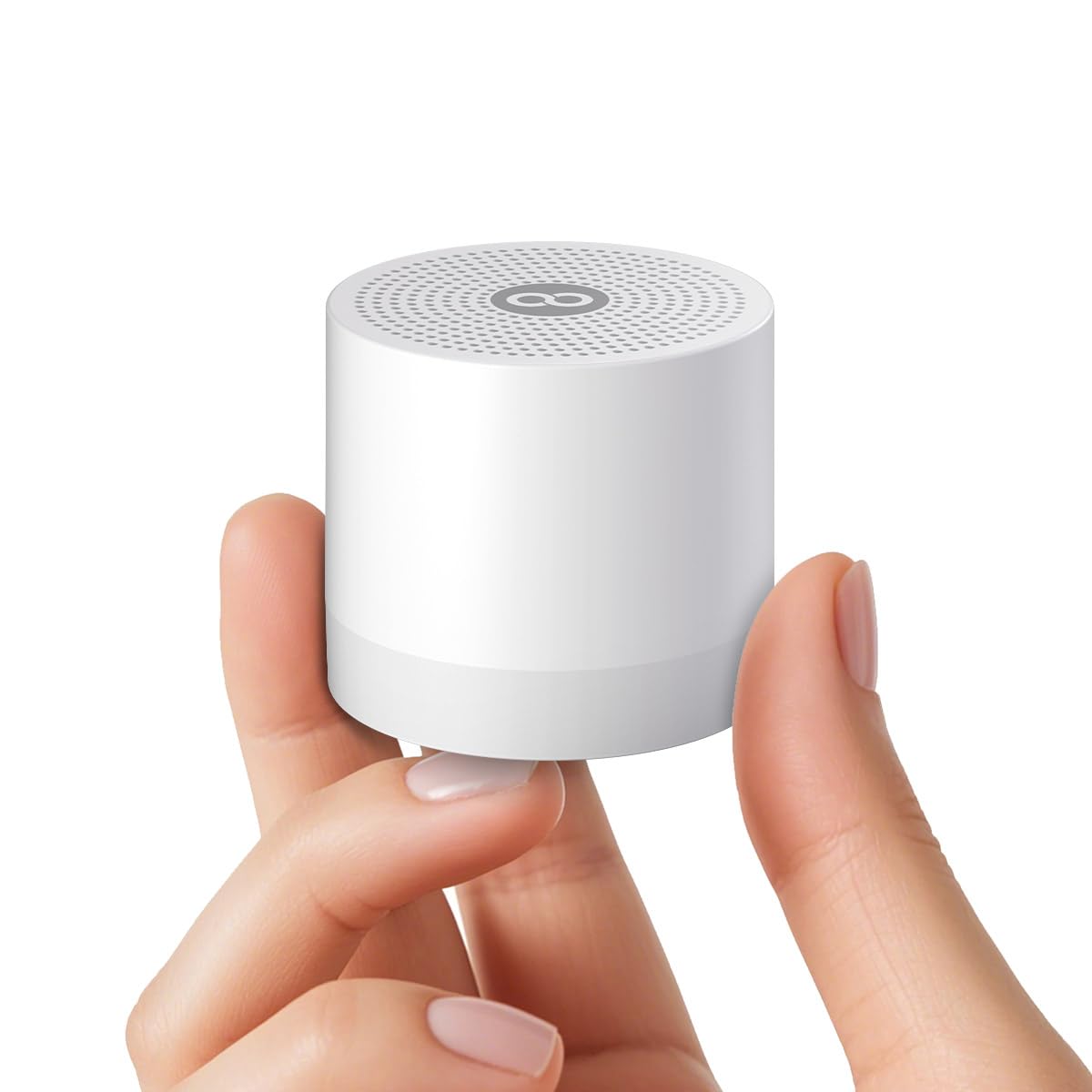
Twenty sounds, USB-C and a clip: on paper the Jaroco covers more of the portable checklist than anything else here, and it does it at a midrange price rather than a premium one. The clip is the detail that earns its keep. Hang it off a diaper-bag strap or a stroller bar and the machine travels with the baby instead of riding at the bottom of the bag.
That combination is why it’s our default recommendation. The stated 15 hours a charge covers a night plus a nap, and USB-C means the cable already in your phone bag tops it up — one fewer charger to remember on a trip. The body is palm-sized at 2.6 inches across, so it disappears into a pocket when it isn’t hanging off something, and there’s no app, no Wi-Fi and no pairing to sort out in a dark nursery.
Twenty sounds is more than any baby needs. The white noise and the ocean are the two we kept coming back to, with heartbeat and shush there for babies who prefer them, and the timer is a button sequence rather than a switch, so read the little card once and then forget it.
Where it gives ground is at the top of the volume range. This is a small speaker, and the thinner tracks — the birds, the twinkle — start to sound brittle when you push them, while broadband white noise and rain hold up. If your nursery backs onto a main road and you need real weight behind the sound, the Dreamegg is the better tool. For everything else, this is the one we reach for.
Pros
- Twenty sounds, including heartbeat and shush
- USB-C charging from your phone cable
- Clips onto strollers and diaper bags
- At least 15 hours per charge
Cons
- Timer takes a button sequence to set
Our default pick for most families: the widest sound menu here, USB-C charging and a clip that keeps it on the stroller, for less than the polished alternatives.
Best for Design-First Nursery
Hatch Go
Key Features
- Size: 6 x 2.76 x 2.17 inches
- Sounds: 10
- Battery: Up to 15 hours
- Charging: USB-C
- Price: Premium
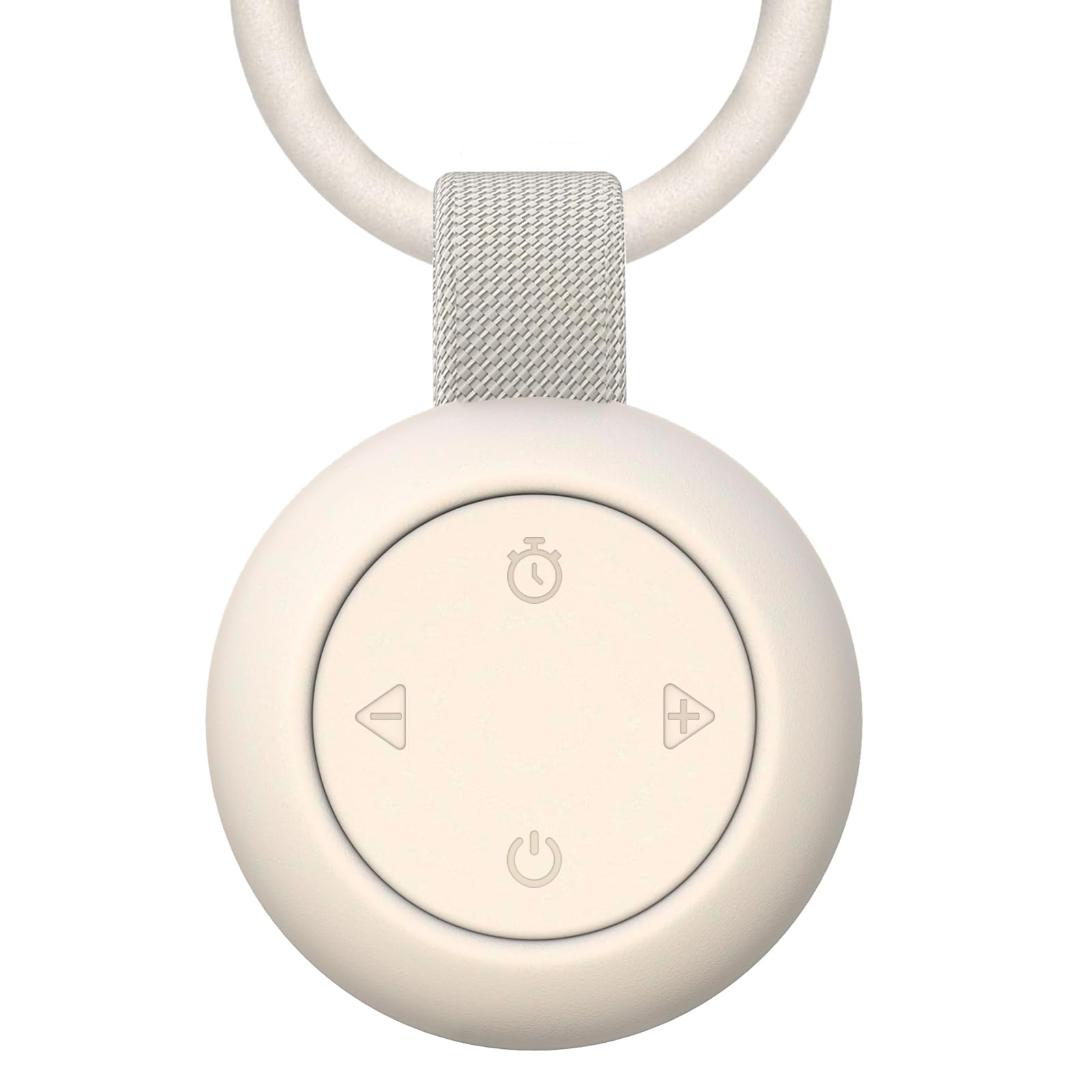
Three buttons, no app and a shell that survives a drop: the Hatch Go is for parents who don’t want bedtime to involve a phone. We think that simplicity is worth paying for. Press for power and volume, tap through ten sounds, and hang it by its ring on a stroller, a car-seat handle or a hook by the crib.
The travel credentials are real. The battery is rated to 15 hours and the machine keeps playing while it charges, so a hotel room with one spare outlet still gets a full night out of it. The recycled-plastic body comes in six muted colors, which sounds like a small thing until you’re deciding whether it can sit on a shelf in a room you actually like.
What it won’t do is fill a loud room. The ten sounds, heartbeat and shush included, are smooth and pleasant rather than forceful, and the volume tops out earlier than on the Jaroco or the Dreamegg — fine in a quiet nursery or a hotel room, lost against traffic or a house full of visitors. If your baby needs a wall of white noise to settle, this is the wrong machine however nice it looks.
Two practical details keep it in the running: it carries a one-year warranty, and the controls are obvious enough that a babysitter can work them without a tutorial.
Pros
- Three-button control with no app or Bluetooth
- Keeps playing while it charges
- Ring clips to strollers and car seats
- One-year manufacturer warranty
Cons
- Most expensive pick in this group
The best-looking and easiest to live with of the group, and the right buy if you want three buttons and no app — as long as your rooms are quiet.
Best for Loud Rooms
Dreamegg D11 Max
Key Features
- Size: 4 x 3.7 x 1.8 inches
- Sounds: 21
- Battery: 1,800 mAh
- Charging: USB
- Price: Midrange
An 1,800 mAh cell is a large reserve for a machine that fits in your hand, and that’s the reason to look at the Dreamegg. It means you charge it when you think of it rather than when it dies, which on a week-long trip is the difference between a reliable bedtime and a nightly scramble for the cable.
Twenty-one sounds is the widest menu here, covering white-noise variations, thunder, rain and lullabies, and the volume runs higher than on the Hatch Go or the Jaroco. That headroom is what makes it the pick for a nursery on a busy street, or for a bedroom where one adult snores and the other doesn’t.
The child lock is what earned it a permanent place in our bag. Around the time your baby discovers that buttons do things, every sound machine becomes a toy; the lock switch stops the 2 a.m. remix without moving the machine out of reach. The timer also fades the sound out instead of cutting it, which is a small kindness at bedtime.
It isn’t a pocket machine. At 10 ounces and 4 inches wide it wants a shelf or a nightstand, and the shell is the weak point — a drop onto a hard floor can end it, so it travels in a suitcase rather than swinging from a stroller bar. Treat it as a nursery appliance that comes on holiday, and the trade is worth making.
Pros
- Twenty-one sounds, the widest menu here
- Large 1,800 mAh battery reserve
- Child lock stops toddler meddling
- Goes louder than the other picks
Cons
- Heaviest of the picks at 10 ounces
For a loud room or a button-mad toddler, the D11 Max’s 21 sounds, big battery and lock switch are worth the extra weight.
Best for Small Bags
Hushing Mini Sound Machine
Key Features
- Size: 1.87 x 1.87 x 1.71 inches
- Sounds: 30
- Timers: 30, 60, 90 minutes or continuous
- Battery: Up to 32 hours
- Price: Budget
At 1.87 inches on a side and 3.68 ounces, the Hushing Mini is smaller than a deck of cards and about as heavy as a set of keys. That’s the whole argument: it drops into a pocket, a cup holder or the corner of a changing bag, and you forget it’s there until the baby needs it.
It also runs longer than anything else here — up to 32 hours a charge, which covers a weekend away without the cable — and 30 sounds with 32 volume steps gives you room to find the exact level that settles your baby rather than the nearest one. The memory function picks up on the sound and volume you left it on, so there’s no fumbling back to your setting at naptime.
We like it best as a nursery machine that moonlights as a travel one. On a dresser it’s unobtrusive; in a hotel room it’s the only one here you could genuinely lose in a washbag. Thirty-two volume steps sounds excessive until you’re in a small room at 3 a.m. and the gap between steps two and three is the difference between sleep and a wake-up.
The compromise is handling. Everything happens through small buttons on top, and for the first week you’ll be finding them by feel in the dark. Learn the layout before the lights go out and it stops mattering.
Pros
- Pocket-sized 1.87-inch cube
- Up to 32 hours per charge
- Thirty sounds and 32 volume steps
- Timers plus a continuous setting
Cons
- No clip or strap for stroller mounting
The smallest and longest-running machine in this group, and our pick when luggage space is the constraint — provided you don’t need it to hang from a stroller.
Best for Stroller Naps
Skip Hop Stroll & Go Owl

Key Features
- Size: 4 x 3 x 5.5 inches
- Sounds: 2 lullabies, 2 nature sounds
- Timers: 15, 30 or 60 minutes
- Mounting: Silicone strap
- Price: Budget
Skip Hop’s owl is a soother rather than a white-noise machine, and that distinction does most of the work. The four sounds are two lullabies and two nature loops — waves and rainforest — with no true white noise among them, so a baby who needs broadband noise to blot out the house won’t be fooled by it.
What it does, it does charmingly. A silicone strap wraps around a stroller bar, a car-seat handle or the strap of a diaper bag, and the molded owl shape gives small hands something to grab. Volume control, three timer settings and a rubber keypad you can work one-handed round out a tidy package, and for the twenty minutes before a nap we found it earns its place.
Play stops after 60 minutes at the longest, which makes it a stroller and nap machine rather than an overnight one. If you need all-night sound, this isn’t the pick — no workaround gets around it. That’s a narrow brief, and it’s a good thing to be good at: the strap means it’s always on the stroller rather than in a bag somewhere, and it’s the least expensive way here to keep a baby calm on a walk.
Pros
- Silicone strap fits stroller and car seat
- Two lullabies plus waves and rainforest
- 15, 30 and 60 minute timers
- Lowest price of the picks
Cons
- Softer than the rest over road noise
A cheerful, cheap stroller soother with a strap that goes anywhere — the right buy for walks and car rides, not for all-night sleep.
How We Tested Portable Sound Machines for Baby
We started by pulling together a shortlist of more than two dozen portable sound machines from our own research and reader suggestions, then narrowed it by size, price, and battery claims to 14 models we could test side by side. The goal was to cover the real spread—pocket-size units that clip to a stroller, slightly larger ones that sit on a nursery shelf, and a few that double as travel night-lights. Every unit was charged fully before testing and used daily for four months.
Battery life was measured, not guessed. We ran each machine at a typical nap volume—loud enough to mask a hallway vacuum, not so loud it rattled the crib—and timed how long it took to die from a full charge. We also tracked how quickly it recharged and whether the battery still held a full session after repeated cycles. Sound quality got the same treatment: we listened for harsh highs, a thin or tinny edge, and audible looping gaps in the white noise, then cycled through every sound option to see which were genuinely soothing and which were just filler.
Portability and size were tested in motion—clipped to a stroller canopy during walks, dropped into a diaper bag, set up one-handed in a dim room during a contact nap. We noted which clips felt flimsy, which units were too bulky for a diaper bag pocket, and which were light enough to hang from a crib rail without sagging. Durability came from daily life: we knocked units off a nightstand onto a rug and a hardwood floor, wiped them down with baby wipes, and kept using them for four months to see whether buttons stuck, settings reset, or the plastic cracked. We also weighed each unit’s price against its actual features, because a machine with 30 sounds you’ll never use isn’t a better value than one with five good ones.
How to Choose a Portable Baby Sound Machine
The machine that actually gets used is the one that’s still charged and already hanging off the stroller when a nap collapses, so runtime and mounting decide more than the track count on the box.
Can it play all night?
Two very different products hide behind the same label. Some are soothers: they run a lullaby or a wave loop for 15, 30 or 60 minutes and stop, which is perfect for a stroller nap and useless at 2 a.m. Others offer continuous play or a timer long enough to cover a night. If the machine is going on a nightstand, this is the feature that decides the purchase.
Check the timer options before you order, and look for one that fades the sound out rather than cutting it — a hard stop is its own wake-up. The Skip Hop’s one-hour maximum is the clearest example of a soother that shouldn’t be asked to do overnight duty.
Battery, cables and the outlet at 2 a.m.
Runtime figures for pocket machines cluster around 15 hours, with the smallest ones claiming roughly double that. Fifteen hours is a night plus a nap; 32 hours is a weekend away without the cable. The difference only matters on trips, which is exactly when you’ll care about it.
The connector is the more practical question. USB-C means the cable already in your phone bag will do the job, micro-USB means one more to remember, and AA cells mean buying batteries at the worst possible moment. A machine that plays while charging, as the Hatch Go does, turns a flat battery into a ten-minute inconvenience rather than a lost night.
Volume ceiling beats sound count
Every machine here has a small driver, so the question isn’t how many sounds it holds but whether it can rise above the room. White noise and rain mask well because they cover a wide band of frequencies; a lullaby soothes without blocking the television or the traffic.
Listen to the top of the volume range rather than the middle. A machine that only just fills a quiet nursery will vanish in a car or a hotel, and no number of extra tracks fixes that. Where two picks are otherwise close, the one with more usable headroom is the better buy.
Mounting, controls and the long haul
Work out where it will live before you choose. A clip or ring earns its place on a stroller bar and a diaper-bag strap; a freestanding cube suits a nightstand, a hotel sill, or a parent who moves it between rooms. Then think about 2 a.m.: can you find the controls without looking, and is there a lock to stop a toddler remixing the sound mid-night?
Finally, accept that small rechargeable cells age. Charge with the cable that came with the machine, keep it out of a hot car, and keep the receipt — the Hatch Go and the D11 Max both state a one-year warranty.
Frequently Asked Questions
Can I leave a portable sound machine plugged in overnight?
Yes, and it’s the easiest way to guarantee a full night. The Hatch Go is the one here designed to keep playing while it charges, so a low battery costs you nothing at bedtime; with the others, check that the machine runs while plugged in before you depend on it.
Route the cable away from the crib and out of a toddler’s reach, and don’t run it under bedding or a mattress.
White noise or lullabies for a baby?
They do different jobs. White noise masks the house — the doorbell, the dog, the older sibling — while a lullaby works as a sleep cue that tells a baby what comes next. Many families use both, noise at bedtime and a song while winding down.
If you haven’t learned which one your baby settles to, buy a machine that carries both rather than guessing twice. The Jaroco and the D11 Max have the widest spread of each.
How far from the crib should the machine sit?
Across the room rather than against the crib, and never inside it. Put it on a dresser or shelf a few feet away, then test from the doorway: if you can hear the sound clearly from there, it’s loud enough from the crib without being loud in your baby’s ear.
On the road the same rule applies — clip it to the stroller canopy or a bag strap rather than next to the baby’s head.
Final Verdict
Start with the Jaroco. It gives you the widest sound menu, USB-C charging and a clip that keeps it on the stroller, and it costs less than the two machines that beat it on looks or on volume.
Choose the Hatch Go if you want the simplest controls and the nicest object in the nursery, the D11 Max if the room is loud or a toddler is on the loose, and the Hushing Mini if your diaper bag is already full. The Skip Hop is the cheap answer to stroller naps specifically — nothing more.
