This post contains affiliate links. We may earn a small commission when you buy through our links — at no extra cost to you.
The first diaper change you do on a fold-down table in a restaurant restroom tells you plenty: whether the wipes are findable one-handed, whether the zipper opens without a fight, whether the changing pad actually covers the plastic. A good bag prevents all of that — no dumping the whole thing onto a counter to find a pacifier, no aching shoulder on the walk home. My team and I have carried 14 of them over the past eight months, through daycare drop-offs, weekend trips, and more parking-lot changes than I care to count.
Capacity and usability aren’t the same thing: a cavernous single-pocket tote holds everything and finds nothing. Appearance counts too — plenty of us want a bag that doesn’t announce itself at brunch — but looks won’t rescue zippers that separate under load, and the bags that survive babyhood are the ones built on real hardware. We weighed all of it, value included, and the picks below are the ones that made the hard days easier.


Best for Everyday One-Bag Days
RUVALINO Diaper Backpack
Key Features
- Pockets: 18
- Capacity: 25 L
- Changing pad: 23 x 15 in
- Empty weight: 1.8 lb
- Price: Midrange
The top of this bag opens out like a mouth instead of unzipping down a slot, and that one decision changes how the whole thing feels to use. You can see the entire main compartment at once, park the flap out of the way, and close it with one hand on the dual zippers — the difference between packing with a baby on your hip and waiting until someone else is home. It’s why this is the bag we recommend first.
The 18 pockets are laid out for the way a change actually goes: diapers in the main compartment, wipes in the side pocket you can reach without unzipping anything, bottles standing up in the insulated holders, a pacifier case that lifts out, and a padded sleeve that swallows a 15-inch laptop. At 25 liters it holds a full day for one child plus your own wallet, phone and a spare sweater. In the austere gray it reads as a plain daypack, which is why it’s the bag that actually leaves the house.
We carried it loaded for a long afternoon and the padded, adjustable straps stayed comfortable, with the top handle handy for lifting it in and out of the car. The waterproof polyester shell means a leaking bottle is a wipe-down rather than a wash, and the stroller straps get it off your back entirely when you’re pushing.
Capacity is the one thing to think about before you buy. Twenty-five liters is a day-out bag, not a two-child bag: pack for a toddler and a newborn and you’ll be out of room by lunchtime, which is exactly where the ROSEGIN’s 35 liters comes in.
Pros
- Wide top opening works one-handed
- 18 pockets separate diapers, bottles and wipes
- Waterproof shell wipes clean
- Padded straps stay comfortable loaded
Cons
- Hand wash only, so no machine cycle
We point most parents here: the top opens wide enough to see everything, the 18 pockets hold a full day, and the waterproof shell wipes clean.
Best for Two Kids, Long Days
ROSEGIN Diaper Backpack
Key Features
- Pockets: 16
- Capacity: 35 L
- Empty weight: 1.6 lb
- Bottom access: Rear zip panel
- Price: Midrange
Thirty-five liters makes this the biggest bag in the group, and it weighs 1.6 pounds empty — two-tenths of a pound less than our 25-liter top pick. Volume usually arrives with bulk and a heavy frame, so that combination is the first thing that got our attention.
The feature we ended up valuing most is the back panel. Swing the bag off one shoulder, unzip the rear, and you’re looking at the bottom of the main compartment — the layer where the spare clothes and the last clean diaper always end up. Front-opening bags make you unpack to get there. For a full day out with two children, or a long stretch away from the house with a pump, this is the one we reach for.
It’s the most travel-ready of the big bags too: a 15.6-inch laptop sleeve and a luggage sleeve that slides over a carry-on handle, in a 900D Oxford shell that is the thickest fabric here. Two practical notes. The care instructions say spot clean only, so keep wipes in an outside pocket for the inevitable. And the front carries a logo the product photos play down — small, but there if you wanted something anonymous.
Pros
- 35 liters, the most capacity here
- Rear panel reaches the bottom without unpacking
- 1.6 pounds empty despite the size
Cons
- Bulky when you’re only packing for an errand
Pick this one when volume is the problem — 35 liters, a 1.6-pound frame, and a rear panel that reaches the bottom.
Best for Work and Travel
Skip Hop Forma Next
Key Features
- Pockets: 9
- Capacity: 20 L
- Empty weight: 1.3 lb
- Packing cubes: One insulated, one mesh
- Price: Premium
Two packing cubes come with this bag, and they do more for it than any pocket. One is insulated for bottles and snacks, the other is mesh for diapers and a change of clothes; both lift out and sit on the changing table so you’re not unpacking a backpack onto a public restroom counter.
The bottle pocket is the other detail that separates it. Most insulated sleeves on a diaper bag are cut for a narrow baby bottle and nothing else, so they’re dead weight the moment you’re carrying your own drink. This one expands to take a big tumbler complete with its handle. Add a padded mesh back panel, a luggage sleeve, a 14-inch laptop sleeve and a wipe-clean changing pad, and 1.3 pounds empty is light for a bag this organized.
What it isn’t is a volume play. Nine pockets and 20 liters is less storage than the cheaper bags here, so the premium buys the organization, the finish and the travel features rather than raw space. For one baby and a parent who wants a bag that works as a work backpack on Monday and a diaper bag on Saturday, that’s a fair trade. Pack for two children and it isn’t.
Pros
- Two packing cubes work like drawers
- Bottle pocket expands for big tumblers
- Luggage sleeve and 14-inch laptop sleeve
Cons
- Less capacity than bags that cost less
Worth the premium if you want a system rather than a sack: packing cubes, a luggage sleeve, and a bottle pocket built for adult drinks.
Best for Bottle Feeding
Dikaslon Diaper Backpack
Key Features
- Pockets: 19
- Capacity: 26 L
- Empty weight: 2 lb
- Insulated pockets: 5
- Price: Midrange
Five insulated bottle pockets is the reason to pick this one. If you’re pumping at work, or mixing formula for a toddler while keeping a bottle cold for a newborn, the bottles get their own sleeves instead of being stacked into one compartment — and that makes it our pick for bottle-feeding logistics.
The rest of the layout is built for speed: 19 pockets, a wipe pocket on the outside so you’re not unzipping the main compartment with a dirty hand, a key loop, and a wide opening on smooth dual zippers that close one-handed. The removable pacifier pod holds two and lifts out on its own.
Open the box against the accessory list before you fill it — the pacifier pod is removable, and it’s the piece that can be missing from the set. If bottle feeding isn’t a big part of your week, those five sleeves are wasted space, and our top pick carries a day’s gear in a lighter bag.
Pros
- Five insulated bottle pockets
- Outside wipe pocket and key loop
- Wide dual-zip opening works one-handed
Cons
- Two pounds empty, heavy before you pack it
- Water-resistant rather than waterproof
The bottle-feeding bag here: five insulated pockets, 19 compartments, and a wipe pocket you can reach without opening the main zip.
Best for Quick Trips, Dads
Mancro Diaper Backpack
Key Features
- Pockets: 12
- Capacity: 20 L
- Warranty: 2 years
- Insulated pockets: 2
- Price: Budget
Nearly nineteen inches tall and seven and a half deep, the Mancro hangs flat against your back rather than sitting out behind you. Plain black, no prints, no quilting — in a category where most bags announce themselves, this one looks like a backpack someone bought for a commute.
That’s the point, and it’s why this is the bag we suggest for a partner who won’t carry a patterned tote, or as the second bag that lives in the car. You get two insulated pockets that take bottles up to 11 ounces, a wipe pocket, stroller clips and a two-year manufacturer warranty, in a 20-liter body small enough to keep packed in a footwell.
The compromise is layout. Those insulated pockets zip shut instead of sitting open on the outside, so a bottle takes two steps when you’re in a hurry, and 20 liters makes this a short-trip bag rather than an all-day one. If your outings are two hours and a coffee, that’s the right size. If it’s a whole day with two children, take a bigger bag.
Pros
- Two insulated pockets fit 11 oz bottles
- Plain black, reads as a normal backpack
- Stroller clips and a wipe pocket included
- Two-year manufacturer warranty
Cons
- Zip-up insulated pockets slow bottle access
- Small zipper pulls are fiddly when full
A quietly sensible buy for short trips and second caregivers — plain, 20 liters, and fitted with two zip-up insulated pockets.
Best for Daily Errands
BabbleRoo Diaper Backpack

Key Features
- Pockets: 17
- Capacity: 26 L
- Warranty: 180 days
- Insulated bottle pockets: 5
- Price: Midrange
It photographs bigger than it wears. This is a 26-liter pack about the size of a school backpack, and if you’re picturing something you could take on a week away, you’ll be disappointed on arrival. As a bag for a normal day out, though, it’s sized right — it sits close to your back and doesn’t swing when you bend over.
What it does well is separate the day into two main compartments: baby gear in one, your things in the other, with five insulated bottle pockets around them, a wipe pocket, a cushioned changing pad and stroller clips. The front compartment takes a standard bottle; wide-mouth cups and the larger wipes packs are where the space runs out. It’s covered for 180 days.
As the bag that lives by the door, this is our everyday pick: two compartments keep the baby’s things from swallowing yours, and the padded back panel makes a full pack tolerable on a twenty-minute walk. It’s also the one here that most convincingly passes as a plain backpack, which matters if you’re carrying it into an office before a pickup.
Pros
- Two main compartments keep days separate
- Five insulated bottle pockets
- Passes as a plain backpack
Cons
- Runs smaller than the photos suggest
- A pocket zipper can fail early
Our pick for everyday errands: two compartments, five insulated pockets, and a shape that reads as a normal backpack.
Best for Budget and Mess
PILLANI Diaper Backpack
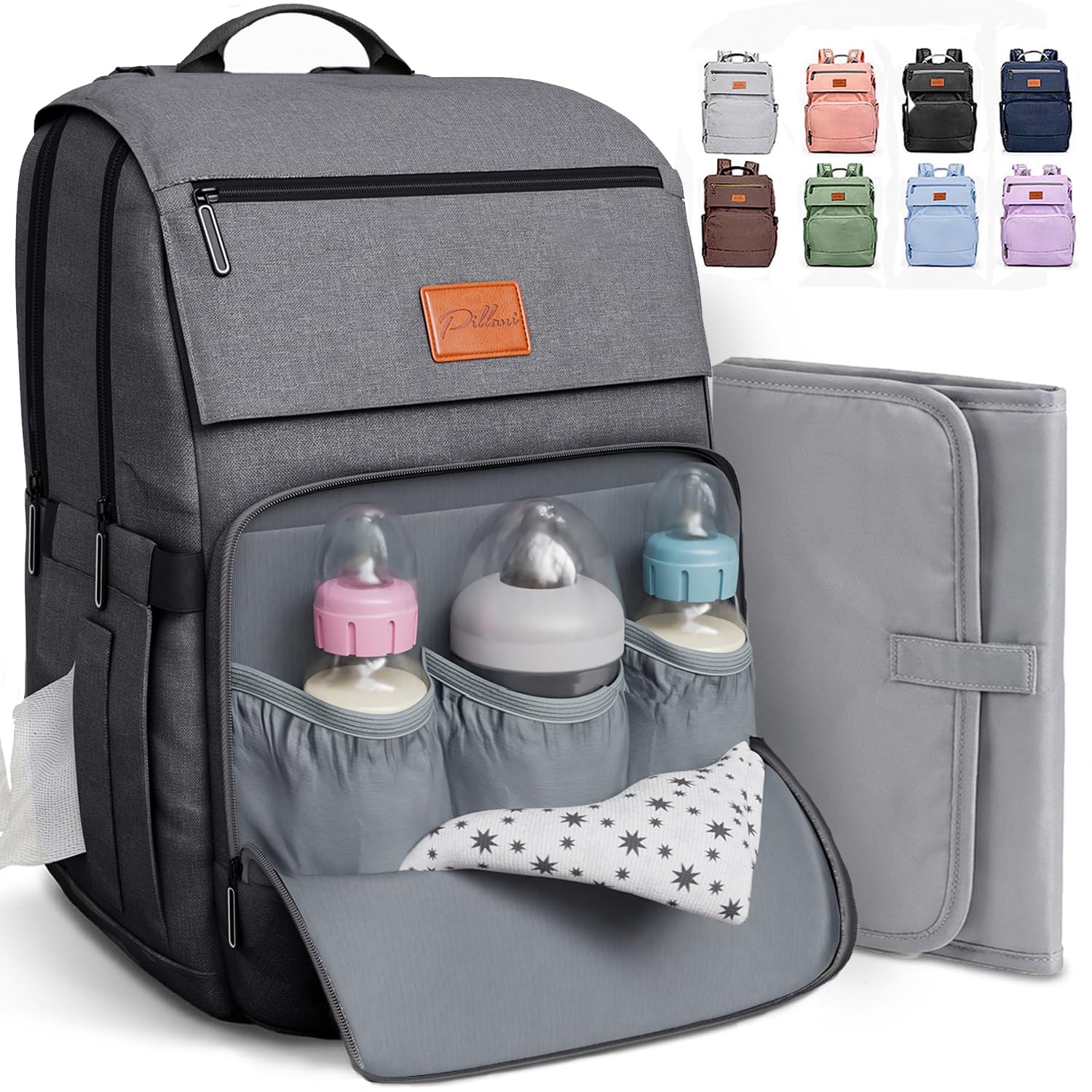
Key Features
- Care: Machine wash
- Fabric: 300D Oxford
- Pockets: 16
- Capacity: 26 L
- Price: Budget
This is the only bag here you can put in a washing machine, and once a bottle has exploded inside a diaper bag, that line on the care tag is worth more than any pocket count. Everything else in this group is hand wash or spot clean only.
The rest is a big, plain 26-liter backpack: 16 pockets, a wide opening, bottle pouches across the front, a 15-inch laptop sleeve and a waterproof 300D Oxford shell. In gray it doesn’t look like a baby product, which is most of the reason it gets carried.
It’s a big bag that doesn’t compress, though. Half full, it’s still a box on your back, which makes it a car-and-stroller bag rather than one you’ll want on your lap on a bus. The wide opening earns its keep there — you can see the whole 26 liters at once, and the front pouches keep bottles upright instead of rolling under the diapers. Air it out for a day before the first use; the fabric can arrive with a factory smell that fades.
For a first bag on a tight budget, or as the spare that can go straight into the machine after a bad day, it earns its place. The wash cycle is the feature you’ll be grateful for at two in the morning, and it’s the reason we kept it on this list.
Pros
- Machine washable, alone in this group
- 26 liters and 16 pockets on a budget
- Wide opening and a 15-inch laptop sleeve
- Waterproof 300D Oxford shell
Cons
- Straps and stitching can give out early
- Side wipes pocket is tight for a full pack
What sells it is the wash cycle: 26 liters, 16 pockets, and the only machine-washable fabric in this group.
Best for Spare Car Bag
Tenot Diaper Backpack

Key Features
- Pockets: 10
- Capacity: 19 L
- Empty weight: 1.54 lb
- Laptop sleeve: Fits 15.6 in
- Price: Budget
At 1.54 pounds empty and 19 liters, this is the bag that doesn’t feel like one. It sits flat against your back, it doesn’t drag on a shoulder, and it doesn’t take up the whole passenger seat — which is the case for owning a small diaper bag at all.
Ten pockets is roughly half what the big bags here carry, so diapers and clothes end up stacked in the same compartment. The insulated front pockets are the bright spot: sized for bottles and easy to reach without opening the main zip. There’s a 15.6-inch laptop sleeve, and the fabric is water-resistant rather than waterproof.
Weight is where the money went. The bag is light enough that you notice it less at the end of a day than the 25- and 26-liter picks, and the shoulder straps adjust far enough for a taller adult. It’s hand wash only, so deal with spills while they’re fresh rather than at the end of the week.
Where this belongs is the car, a grandparent’s hallway, or short outings once you’re past the newborn stage. It’s the cheap second bag that stops you hauling the big one everywhere, and at 19 liters it’s honest about what it is.
Pros
- 1.54 pounds empty, light on one shoulder
- Insulated front pockets hold bottles upright
- Fits a 15.6-inch laptop
Cons
- Straps and insulated-pocket seams can tear
For a spare bag that lives in the car, 1.54 pounds and 19 liters is plenty — just don’t make it your only one.
How We Tested: Eight Months of Daily Use With 14 Diaper Bags
We built the shortlist from specs and customer reviews, then cut anything that couldn’t be worn crossbody for a second caregiver, slid under a stroller, or held a full day of supplies for a toddler. That left 14 bags in backpack, tote, and messenger shapes, and each one saw at least a month of the eight-month test — several went the whole distance.
They went everywhere a real bag goes: daycare drop-off, a full day at the zoo, a flight with a lap infant, the dark corner of a nursery at 2 a.m. We packed each to its claimed capacity with diapers, wipes, two bottles, a change of clothes, and snacks, then noted how much digging it took to pull a wipe out one-handed while holding a baby.
Zippers got their own attention. We loaded bags until the seams pulled, then ran the main zipper open and shut dozens of times, watching for snags at the corners and teeth that separated under weight. Changing pads were measured against an actual toddler, smeared with diaper cream, and wiped down to see what stained. Every bag also hung from a stroller handle to check whether it dragged the stroller backward, and we wore each one on a two-mile walk in a winter coat to see if the straps stayed put.
Looks stayed in the mix as a real criterion rather than an afterthought — testers carried bags as everyday purses for weeks to see whether anyone clocked them as diaper bags. After months of daily use we inspected strap stitching, seam stress, and base fabric, then weighed what each bag actually delivered in pockets, hardware, and pad against what it asked you to spend.
How to Choose a Diaper Bag
A diaper bag gets opened one-handed dozens of times a day, so the opening, the pocket layout and the zipper matter more than the liter count on the listing.
Match capacity to the trips you actually take
The bags here run from 19 to 35 liters, and that spread covers three different jobs. Around 20 liters is a short-trip bag — a change of clothes, a few diapers, a bottle — and it’s the size that stays packed in the car. The 25- to 26-liter bags are the everyday sweet spot for one baby plus your own wallet, phone and a spare layer. Past 30 liters you’re packing for two children or carrying pump gear, and you’re also carrying a bag that feels like luggage when it’s half empty.
The trap is reading liters as usable space. Volume tells you nothing about reach: a wide-mouthed 26-liter bag you can see straight into beats a 35-liter sack you have to unpack to find a diaper, every time.
Test the opening and the zipper before anything else
Sixty seconds with a bag tells you most of what you need to know: can you open it with one hand, can you see the bottom of the main compartment, and does the zip run around the top so the bag opens like a mouth rather than a slot? That’s the difference between finding a diaper in a dim restroom and taking everything out onto a changing table.
The zipper is also what ends a bag’s working life. A broken pull on the main compartment turns a backpack into a sack, and the closure is the one place where saving money shows up fastest. Favour dual zippers with substantial metal pulls, and check that the sliders move freely when the bag is stuffed rather than empty.
Decide how you’ll carry it
Backpacks win for stairs, car parks and any trip where you’re also carrying a car seat; a top handle matters more than you’d think for lifting the bag out of a footwell without unbuckling anything. Totes and shoulder bags are easier to get into when the bag is beside you, but you lose a hand.
Stroller clips are useful and conditional. They only work where your stroller has an attachment point, and a loaded bag swinging from the push handle can tip a stroller backwards — clip low on the frame instead. Whatever you choose, put empty weight high on the list: a two-pound bag becomes an eight-pound one once it’s packed for a day.
Give the things you touch most their own pocket
Think about the five things you handle at every change — wipes, a diaper, the changing pad, a bottle, your phone — and check each has a home you can reach without unpacking the bag. An outside wipe pocket is the single most useful feature on a diaper bag, because wipes are the thing you need with one dirty hand already occupied.
Bottle storage matters in proportion to how you feed. One insulated sleeve covers a short outing with a single bottle; five of them, as on the Dikaslon, is about pumping or keeping a day’s worth of milk at temperature. Count the bottles you actually leave the house with before you pay for sleeves.
Weigh fabric and cleaning against each other
Waterproof and water-resistant are not the same claim. A waterproof shell handles a leaking bottle; a water-resistant one buys you time to find a sink. Thicker Oxford fabric feels more robust and adds weight, and the trade you’ll actually notice is care: most bags here are hand wash or spot clean only, which is fine until something curdles in an inner pocket on a hot day.
If you know you won’t stand at a sink with a sponge, buy the one bag in this group that goes in a washing machine and accept the lighter fabric that comes with it. That single decision will matter more over two years than any pocket count.
Frequently Asked Questions
Do I really need a diaper bag, or will a regular backpack work?
A plain backpack will carry diapers, but it won’t give you insulated bottle pockets, a wipe pocket you can reach one-handed, a wipe-clean lining or a changing pad. If you’re already adding a wet bag and a changing mat to your own pack, you’ve built a worse diaper bag.
Try a week with the backpack you own. If you keep hunting for wipes at the bottom of it, buy the real thing.
What should I pack in a diaper bag for a full day?
Pack for changes first: a changing pad, wipes, a few diapers per child, a full change of clothes and a wet bag for anything soiled. Then bottles in the insulated sleeves, a snack for you, and your own wallet, phone and a spare layer.
Then do the honest part. At the end of the day, take out whatever you never touched and stop packing it — most bags are lost to overpacking, not to being too small.
Can a diaper bag double as my work bag?
Several here have padded laptop sleeves: the RUVALINO and PILLANI list a 15-inch maximum, the ROSEGIN and Tenot 15.6 inches, and the Skip Hop 14 inches. Measure your laptop’s diagonal before you commit, because a 14-inch sleeve won’t take a 16-inch machine.
The Skip Hop also has a luggage sleeve that slides over a carry-on handle, which is the other feature worth having if the bag travels with you.
Final Verdict
The RUVALINO is the bag we point most parents to, because the wide opening and the 18 pockets solve the two things that make a diaper bag annoying: not being able to see inside it, and not being able to find anything once you’re in there. It’s the default for one child’s worth of gear plus your own.
Packing for two children changes the answer — go to the ROSEGIN and its 35 liters. If you’re pumping or mixing formula all day, the Dikaslon’s five insulated sleeves earn their space. Everyone else can start with the top pick and stop shopping.
