This post contains affiliate links. We may earn a small commission when you buy through our links — at no extra cost to you.
The day my son worked out that the front door opens if you turn the knob, our baby gates became decoration. Door knob covers aren’t really about the hardware — they buy you a few seconds between a curious toddler and the driveway, the bathroom, or the stairs. A good one spins freely under small hands and still lets an adult with an armful of laundry through in one motion. A bad one pops off for a determined 2-year-old or jams so hard that you’re the one locked out.
One piece of advice before you buy: measure your knobs first. Covers are cut for specific diameters, and round versus oval matters as much as anything on the label. Over the past three months, we’ve had 14 covers in daily use in homes with kids between 1 and 4, and the gaps in fit, grip, and durability surprised me — price had almost nothing to do with it. The picks below all survived real toddlers; the only question left is which one fits your doors.



Best for Most Homes
Jool Baby Door Knob Covers
Key Features
- Knob fit: Most rounded knobs
- Lock access: Front opening
- Installation: Snap on, no tools
- Covers per pack: 4
- Price: Midrange
The opening in the front is the detail that won us over. Instead of squeezing two release points and then twisting, you reach through the hole and turn the knob itself — one motion, one hand, which matters when the other arm is full of baby. That single design choice is why this is the cover we point most households to.
For the toddler, the shell just spins. The front and side openings are sized for adult fingers, so there is nothing to grip and nothing to pull against, and the door stays shut while it is being rattled from the other side. The lock stays usable too: the opening lines up with a push-button or twist lock, so a bathroom door can still be locked from the inside.
Check your knobs before you order. These are built for standard round handles; oval, flat-faced and oversized knobs are a different problem, and the Dreambaby and GRENFU covers below are the ones to look at. On the knobs they are made for, the whole thing becomes a non-event, which is the highest compliment this kind of gear can get.
Pros
- Front opening lets adults turn the knob one-handed
- Free-spinning shell gives small hands nothing to grip
- Lock stays reachable through the front opening
- Four covers at a midrange price
Cons
- Snap tabs are the first part to give out
Our default for a house of standard round knobs: adults reach through and turn, toddlers get a shell that spins, and four covers handle the doors that matter.
Best for Escape Artists
Wappa Baby Door Knob Covers
Key Features
- Locking: Dual-lock tabs
- Knob fit: Standard round knobs
- Material: BPA-free plastic
- Covers per pack: 4
- Price: Midrange
Most covers ask a toddler to fail at one thing: getting a grip on a shell that spins. The Wappa asks them to fail at two, because the halves lock together with tabs that have to be released before the cover comes apart at all — so the tug-and-peel move that eventually defeats a basic cover gets nowhere here.
What we appreciate is that the extra lock costs the adults nothing. The side openings still line up with the knob, the door opens with the same turn as before, and nobody in the house has to learn a new grip. That balance is rarer than it sounds: a few covers in this guide are stiff enough that the grown-ups quietly stop closing the door.
Two practical notes. The semi-clear plastic sits more comfortably on a white door than the brighter white shells here — it reads as hardware rather than baby gear. And it is built for standard round knobs, with enough room inside that a smaller builder-grade knob lets the shell ride forward and rattle when the door moves. It still spins; it just looks untidy.
Pros
- Dual-lock tabs resist being pulled apart
- Side openings keep the door easy for adults
- Best durability showing in this group
- Four covers in a semi-clear finish
Cons
- Rides forward on smaller round knobs
If your toddler has already beaten a basic cover, the dual-lock tabs here add a step most small hands cannot solve, without slowing the adults down.
Best for Tight Budgets
Safety 1st Parent Grip Covers
Key Features
- Knob fit: Most standard knobs
- Projection: 2.5 inches
- Installation: Snap-on polypropylene
- Covers per pack: 4
- Price: Budget
Per door, nothing else here costs less — four covers for the price of most three-packs — and the mechanism is the simplest in the group. The shell spins freely, and to open the door you press the two release points and turn.
The catch is the squeeze itself. It is a firm two-point press that wants both hands, and on a door you pass through twenty times a day it wears thin, particularly with a baby on your hip or for anyone with arthritis. That is a fair trade on the garage or the basement stairs and a poor one on the only bathroom in the house, which is really the whole decision with this cover.
One size fits most standard round knobs; it does not adapt to oversized or decorative handles, so measure rather than committing the pack to four doors. Compared with the other picks here, this is the one we point to for doors that need to stay shut more than they need to be convenient.
Pros
- Lowest cost per door in this guide
- Shell spins free of the knob
- Four covers in the pack
Cons
- Stiff release needs a firm two-handed squeeze
- Some covers have to be broken off
The least expensive way to cover four doors, and the right pick when those doors are not in constant use, because the squeeze is genuinely stiff.
Best for Locking Doors
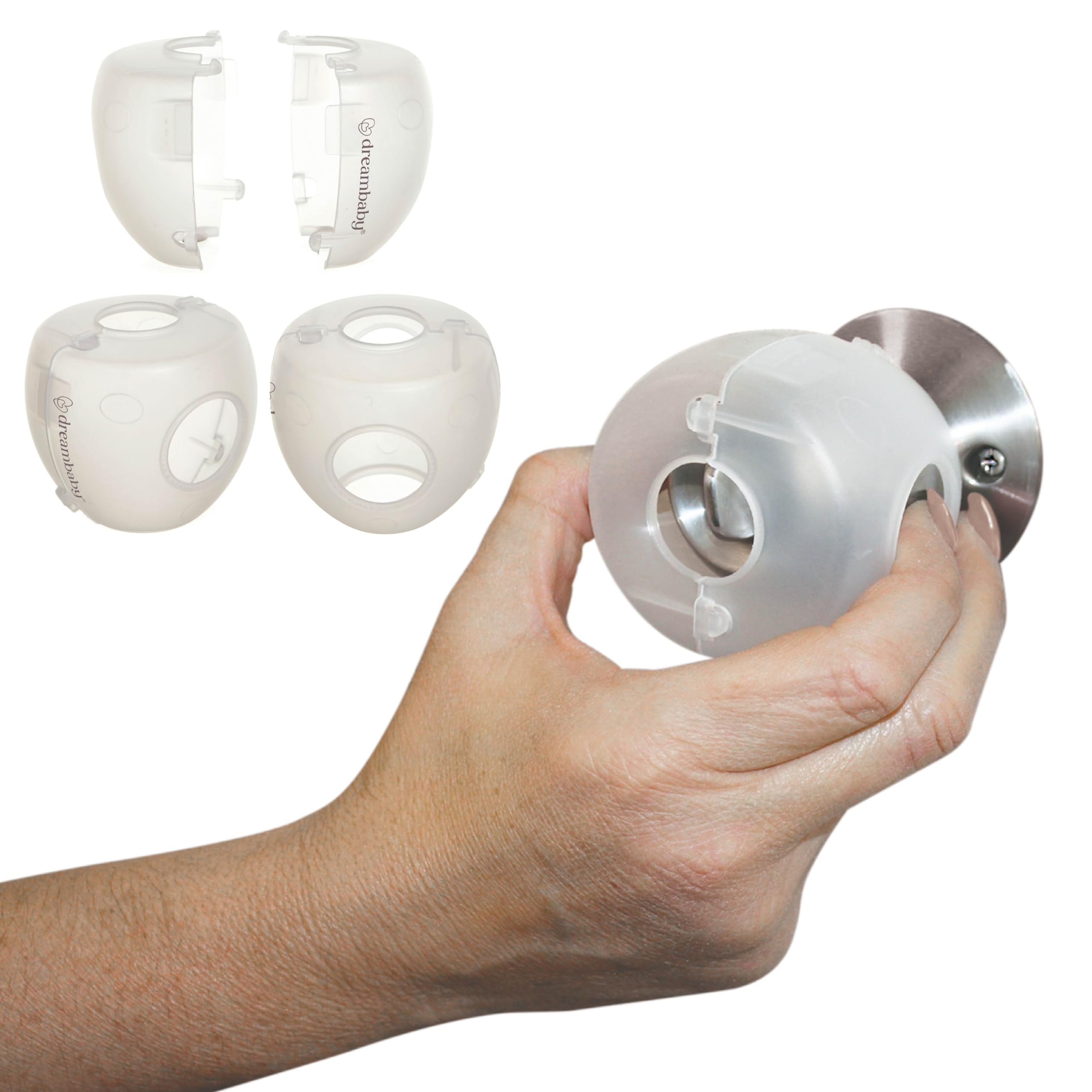
Dreambaby EZY-Fit Covers
Key Features
- Knob fit: Most standard knobs
- Lock access: Push and twist buttons
- Installation: Two-piece snap fit
- Covers per pack: 3
- Price: Budget
A hole lined up with the lock button is why we keep this one on the list. On a bathroom or bedroom door with a push-button or twist privacy lock, a fully sealed cover turns a two-second job into a wrestling match, and on more than one cover here the lock is exactly what ends up buried under plastic.
Size is the other half of the appeal. The two halves snap around most standard knobs, but there is enough room inside the shell for the oversized round handles that leave other covers sitting proud of the door or refusing to click shut. If your house has one fat knob and three ordinary ones, this is the set built for the odd one out.
The catch is the count: three covers, the smallest multi-pack here, so a house with more than three doors to protect is better served by one of the four-packs. For a bathroom and a bedroom it is enough, and the flush fit keeps the door looking almost normal.
Pros
- Access hole keeps push and twist locks usable
- Fits oversized round knobs other covers will not
- Sits flush and blends with the door
Cons
- Thin snap tabs can work loose
The one to buy when a push-button or twist lock still has to work behind the cover, and one of the few that closes over oversized knobs.
Best for Wide Knobs
GRENFU Door Knob Covers
Key Features
- Knob fit: Wide spherical knobs
- Material: Polypropylene
- Installation: Snap on, no tools
- Covers per pack: 4
- Price: Midrange
A cover that is too tight is worse than no cover at all. When the shell hugs the knob it turns with it, and the toddler who was beaten by a spinning shell suddenly has a handle to grab. GRENFU’s whole pitch is being the bigger shell for the wide, oval and crystal knobs that squeeze other covers into exactly that failure.
The extra room is what makes it useful. On a fat spherical or oval handle the shell keeps spinning clear instead of gripping, and there is enough clearance for the cover to sit square rather than cocked off to one side. It is the one we reach for in a house with mixed hardware — the door with the odd handle that nothing else quite fits.
The trade shows up on a small knob: a shell with room to spare slides forward and rattles, and a cover hanging loose looks careless on a nice door. Buy it for the doors where other covers will not close, not as a house-wide solution.
Pros
- Fits wide and oval knobs that stop other covers
- Keeps spinning on fat spherical handles
- Four covers, tool-free snap fit
Cons
- Loose and rattly on smaller knobs
Built a size up for the wide and oval handles that squeeze standard covers into uselessness, though on a small knob the extra room works against you.
Best for Lock Buttons
BETERTEK Door Knob Covers

Key Features
- Material: Polypropylene
- Lock access: Covered lock button
- Installation: Tool-free snaps
- Cover diameter: 2.6 inches
- Price: Midrange
The flap over the lock button is the detail we noticed first. On a door with a push-button privacy lock, that covered section keeps the button out of small hands while still letting an adult get to it, which is more than most of the shells here manage.
The 2.6-inch diameter is the other selling point: it swallows bigger round knobs than the standard covers, which is why it earns a place at all. The same size works against it on a small knob, where the cover sits loose, slides forward, and looks like it is hanging off the door.
Where it gives ground to the picks above is durability. The snaps are the weak point, and on a door your child genuinely wants open they can let go under a hard pull — for a determined three-year-old that is the difference between a deterrent and a delay. On a low-traffic room it is a perfectly reasonable buy; on the door that matters most, the Jool Baby or the Wappa is the stronger choice.
Pros
- Flap keeps the lock button covered but reachable
- 2.6-inch shell suits bigger round knobs
- Tool-free installation with double-lock snaps
Cons
- Snaps can give way under a hard pull
A sensible choice for a door with a lock button behind the cover, though the snaps are the weak point and the fit is a gamble on small knobs.
Best for Measured Fits
Heart of Tafiti Knob Covers

Key Features
- Knob fit: 1.4 to 2 inch round knobs
- Material: PP and TPR
- Installation: Snap-in, no tools
- Covers per pack: 4
- Price: Midrange
Publishing a fit range should be standard in this category, and it is the most useful thing about this set: 1.4 to 2 inches across the knob is a number you can check before you order rather than after.
The rest is the familiar two-half snap. Press until both latches click and the shell spins on the knob while an adult reaches through to turn it, and the plastic wipes clean with a damp cloth. Where this one gets into trouble is at the top of its own range: a knob near two inches fills the shell, the halves can grip instead of spinning, and a determined toddler gets to turn the whole assembly.
On small and mid-size knobs we think it is a good, tidy cover at a fair price, and four of them handles the doors that matter. It just is not a universal answer — measure first, and if your handles sit closer to the top of the range, go up to GRENFU or Dreambaby instead.
Pros
- Published 1.4 to 2 inch fit range
- Snap-in install with no tools
- Wipes clean with mild soap
Cons
- Can grip the knob near the top of its range
Buy it if you have measured your knobs and they sit at the small end of standard; near the top of its range the shell hugs the knob and hands your toddler leverage.
Best for One Door
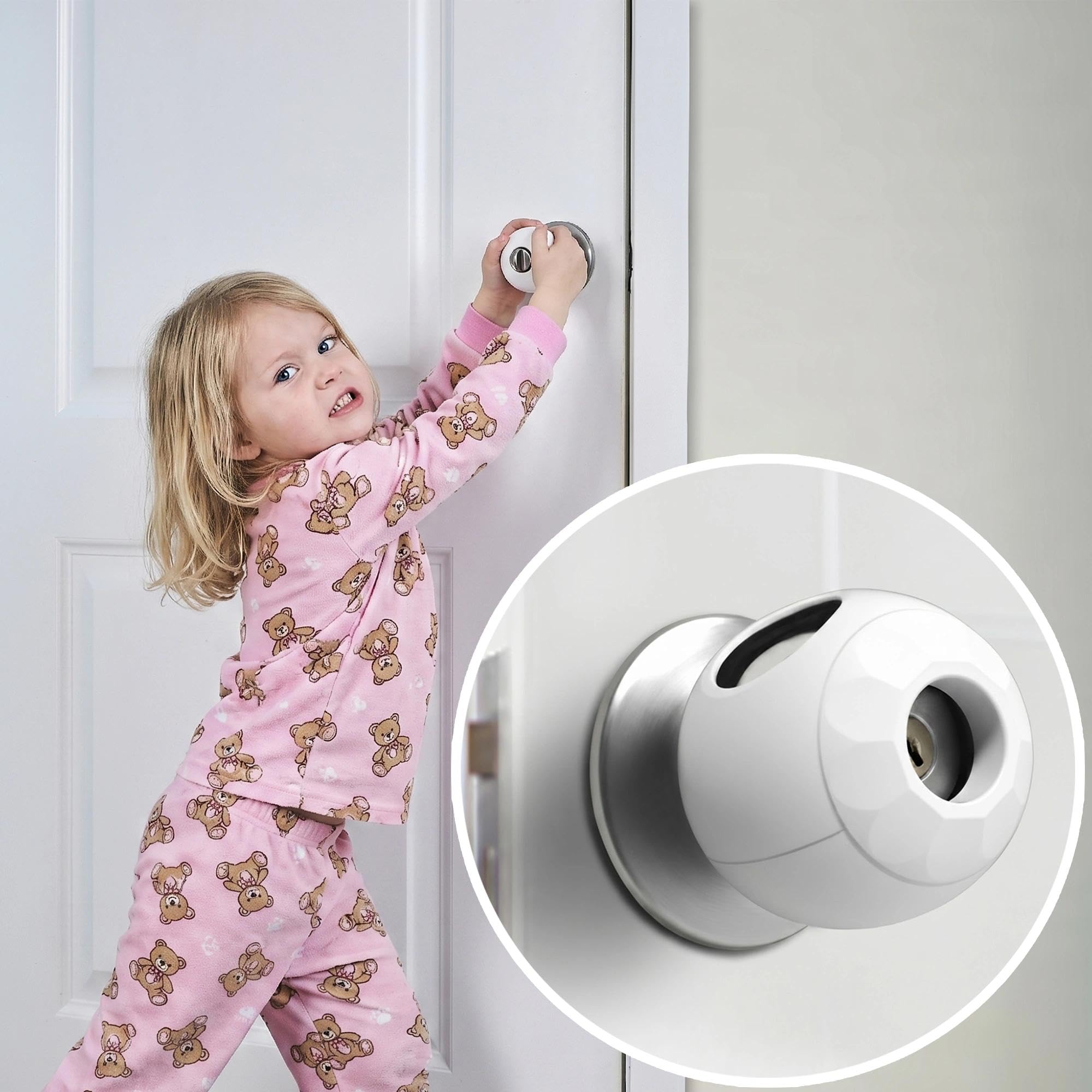
AILUOQI Door Knob Cover
Key Features
- Knob fit: Standard spherical knobs
- Material: Polypropylene
- Installation: No-tool snap-on
- Covers per pack: 1
- Price: Budget
One cover in the pack is either the entire point or a dealbreaker, depending on how many doors you are protecting. For a single door — the top of the stairs, the spare room your toddler has just discovered — buying one instead of a four-pack you will lose in a drawer makes sense.
The shell is hard polypropylene rather than the softer plastic on some covers here, and it spins cleanly on a standard spherical knob while the side holes give an adult room to turn it, which is what we want from a cover this simple. It is plainer-looking than the semi-clear ones, solid white and visible on a white door, but it does the job without fuss.
The cost is per door: as a single, this works out as the most expensive cover here, and a four-pack from Jool Baby or Safety 1st is the better value the moment you have a second door to do. Buy it for the one door that needs covering today.
Pros
- Single cover for one problem door
- Hard plastic shell spins freely
- No tools or adhesive needed
Cons
- Most expensive per cover in this guide
- Slides forward on smaller knobs
Worth it for one problem door and little else: a single hard-plastic cover that costs more per door than any four-pack here.
How We Tested Door Knob Covers
We started by rounding up every cover we could find — big baby-proofing brands, smaller safety shops, the multipacks — then cut anything that wouldn’t clear a standard round knob or that arrived without stated materials. That left 14 covers. We installed them on front doors, bathroom doors, laundry room doors, and a couple of bedroom doors across four households with kids between 1 and 4, plus a set of grandparents’ doors, and left them there for three months.
Every week we watched the kids go at them — pulling, twisting, hanging their weight off the cover — and noted which ones spun smoothly and which came loose, cracked, or popped off in a small hand. Fit got checked on round and oval knobs, on doors with a deadbolt above, and on knobs set close to a frame, where a bulky cover scrapes the trim.
For the adult side, we timed getting through each door one-handed with a laundry basket, then again in the dark, since fumbling for a release tab at 2 a.m. is its own test. We took each cover off and reinstalled it at least twice to see whether the tabs and screws held snug the second time and whether removal needed a tool. Durability was judged on three months of yanking plus a weekly wipe-down, and on whether the plastic clouded, cracked, or yellowed. Value came down to whether the cheapest cover in the group did the same job as the most expensive.
How to Choose Door Knob Covers for Babies
The cover that works is the one that fits your knob and that you can still open with one hand — color, pack size and price are a distant second.
Measure the knob, not the door
Two covers that look identical behave completely differently depending on what they are sitting on. Measure across the widest point of the knob, collar included, and compare it with any range the maker publishes — Heart of Tafiti’s 1.4 to 2 inch figure is the kind of number worth having before you order.
The trap runs both ways. A shell that is too tight grips the knob and turns with it, handing your toddler a handle; one with too much room slides forward and rattles. Round, oval, flat and crystal handles are not interchangeable, and one size usually means one size of round.
Choose a release you can work one-handed
There are two mechanisms in this category. Some covers need both release points squeezed before the knob will turn; others leave a hole at the front so you reach in and turn the knob directly. The second is easier with a baby on your hip, and it is exactly the gap between the Jool Baby cover and the Safety 1st one.
Think about who else opens that door: a grandparent with arthritic hands, an older sibling, a sitter who has never seen the cover before. If a cover is a two-handed operation, the adults in the house start propping doors open, and a propped door protects nobody.
Sort out lock buttons and the doors you escape through
A cover that blocks a push-button privacy lock turns the bathroom into a puzzle. Look for an access hole or flap that lines up with the lock, which is the whole idea behind the Dreambaby cover.
Then think about exits. Anything that slows an adult down also slows them down in an emergency, so cover the doors that keep a child out of danger rather than the ones you need to get out of the house in a hurry. If a cover does go on an exit door, test it yourself the same evening.
Count the doors before you pick a pack
A four-pack is the usual size and it is rarely four spares. Doors get counted twice, a cover goes on crooked and has to come off, and the snap tabs are the part that wears out first.
Count the doors you actually want shut, add one, and compare the cost per door rather than the shelf price — a four-pack that matches the price of a two-pack is the better buy every time. Save the spare for the door you forgot.
Frequently Asked Questions
How do I get a door knob cover off once it’s on?
Press both release points at the same time and pull the halves apart; doing one at a time just lets the tab re-latch. If the tabs sit in a recess, a flathead screwdriver tip in the seam gives you the purchase your fingers cannot get.
Some covers grip so tightly that they come off in pieces, which is worth knowing before you fit one to a door you may want uncovered again.
At what age should we start using door knob covers?
As soon as your child can stand on tiptoe, reach the knob and twist — for many that lands somewhere around 18 months to two years, and the reaching matters more than the birthday. Watch for the two-handed grab, which is the move a cover is built to defeat.
Retirement runs the same test in reverse. Once your child works the release, the cover is decoration and the pressure belongs on a different door.
Do door knob covers damage the door or the knob?
No. Every cover here clips on without adhesive, screws or drilling and comes off the same way, so the door and the knob finish are left alone.
The wear is on the cover: the snap tabs fatigue with repeated removal, and the plastic can scratch if you lever it off with a tool. Wipe them down with mild soap and water instead of scrubbing.
Can a toddler learn to open a covered door?
Yes, and usually by watching you. A child who studies the two-point squeeze can copy it, especially past the age of three, so a cover buys time rather than permanence.
If yours starts working the release, change the setup — a cover with two separated tabs takes longer to solve — and shift the pressure to a door they have not studied yet.
Final Verdict
For our own house, we start with the Jool Baby four-pack. It covers standard round knobs, the front opening keeps both the knob and the lock reachable, and an adult can get through the door one-handed — the thing that decides whether a cover stays on or gets left in a drawer.
If your toddler has already beaten a basic cover, the Wappa’s dual-lock tabs are worth the step up. And if your knobs are wide, oval or oversized, go straight to GRENFU or Dreambaby instead: no cover works on a knob it does not fit, however clever the mechanism.
