This post contains affiliate links. We may earn a small commission when you buy through our links — at no extra cost to you.
Bug spray for kids is a compromise in a bottle: the formulas that keep mosquitoes off the longest often smell like a garage, and the ones that smell like a citrus grove can quit working before the marshmallows come out. I’ve got a seven-year-old who welts up from a single bite and then scratches it for a week, so I stopped buying on scent and started buying on what actually held through an evening. The right bottle ends the dinnertime negotiation — a quick pass at the ankles and wrists, no greasy film on small hands, no tears about the smell.
Over the past four months, my team and I have tested 16 bug sprays made for kids, from drugstore staples to the earnest-looking bottles at the co-op, and the spread between them is wider than you’d expect. One thing worth knowing before you shop: on a label, the percentage of active ingredient tells you how long a formula keeps working, not how strong it is — 10 percent picaridin and 20 percent picaridin protect equally well, they just run on different clocks. The picks below are the ones that earned a permanent spot in the camp bag.


Best for Everyday Kid Coverage
Boogie Insect Repellent Lotion
Key Features
- Size: 6 fl oz
- Format: Lotion
- Protection time: Up to 14 hours (mosquitoes and ticks)
- Active ingredient: 20% picaridin
- Price: Midrange
Spraying a toddler is a two-person job, and half the can ends up in the air rather than on the child. The Boogie lotion removes that problem, which is why it’s the first bottle we hand to a parent: you squeeze a little onto your fingers and rub it in, so there’s no mist to breathe in and no overspray settling on the car seat.
The active is 20 percent picaridin, and the label claims up to 14 hours against mosquitoes and ticks — the longest window on this page. That’s the difference between applying it before a morning ballgame and not thinking about it again until dinner. It’s also genuinely odorless, with a finish closer to hand cream than repellent, and we found ourselves reaching for it on the adults once the good bottle was already out.
Lotion does cost you time. Two kids’ arms and legs take noticeably longer than two passes with an aerosol, and a six-ounce bottle has to be replaced mid-season in a wet July. What you get back is control: you know exactly where the product went, and nothing lands on the sofa or the stroller canopy.
One gap worth knowing about: this label doesn’t print a minimum age. For a baby still in the first year, we take the OFF! lotion that states six months and up and leave this one on the shelf until the following summer.
Pros
- No mist to breathe in or overspray on gear
- Up to 14 hours against mosquitoes and ticks
- Odorless and non-greasy on skin
Cons
- Slower to cover arms and legs than an aerosol
- Pricier per ounce than the budget DEET pick
The one we recommend first: a scent-free picaridin lotion that goes exactly where you put it, which is the whole battle with a toddler.
Best for Babies and Toddlers
OFF! Adults & Kids Lotion
Key Features
- Size: 3.8 oz
- Format: Lotion
- Minimum age: 6 months
- Active ingredient: Picaridin
- Price: Budget
Six months and up. That line on the label is the reason this bottle is on the list at all — a printed minimum age is the first thing we check when a repellent is going on a small child, and here it’s stated rather than implied.
For a household with a baby, that sentence outweighs every spec on the page. The active is picaridin, the formula is fragrance-free, and it goes on like a light cream rather than a coating. We applied it to arms and legs without a wrestling match, and the scent-free finish meant nobody complained about smelling like a chemistry set on the drive home.
The catch is size: 3.8 ounces is a small bottle, and daily summer use has you buying again before the season turns. What we keep coming back to is the texture — it absorbs in seconds, so a shirt can go on immediately after. With a child already late for a birthday party, that’s the whole game.
Pros
- Six-month minimum printed on the label
- Fragrance-free cream that absorbs in seconds
- Gentle on sensitive skin
Cons
- 3.8-ounce bottle empties quickly in daily use
- Mosquitoes only, with no tick claim
Buy this one for a baby: it’s the pick whose label commits to a six-month minimum, and the cream itself is light enough that nobody fights you.
Best for Deet on a Budget
OFF! Family Care
Key Features
- Size: Two 4 oz cans
- Format: Aerosol spray
- Coverage: Mosquitoes, ticks, chiggers, fleas, biting flies
- Active ingredient: 15% DEET
- Price: Budget
Buying repellent for a family of four adds up fast, and this twin pack is the answer we keep coming back to — one can by the back door, one in the car, everybody covered. Fifteen percent DEET is the sensible middle of the road: enough for a backyard evening or a day hike, well short of the deep-woods formulas built for a week in the bush.
The coverage is broader than most of the pricier picks here. It’s labeled for ticks, chiggers, fleas and biting flies as well as mosquitoes, which matters if your summer involves tall grass or a dog. It also goes on dry and stays dry, so arms don’t leave a slick print on a car seat or a sofa cushion.
Two trade-offs. The first blast of scent is strong, though it fades and you stop noticing it once you’re outdoors. And the cans are small — a family using this daily goes through both well before the season ends, which is the price of the low outlay rather than a fault.
Where it isn’t the answer is a baby. This label doesn’t spell out an age the way OFF!’s kids lotion does, so for a child in the first year we take the lotion and leave the DEET can for the grown-ups and the older kids.
Pros
- Covers ticks, chiggers, fleas and biting flies
- Dries fast with no greasy film
- Two cans for less than most single bottles here
Cons
- Strong first blast of scent
- Small cans run out fast in daily use
Our budget DEET pick: two cans that cover ticks and biting flies for a family, as long as everyone in the house is past the baby stage.
Best for Full Days Outdoors
Sawyer Picaridin Spray
Key Features
- Size: Two 4 fl oz bottles
- Format: Pump spray
- Protection time: Up to 12 hours (mosquitoes and ticks)
- Active ingredient: 20% picaridin
- Price: Midrange
The pump is the first thing you’ll have an opinion about. It’s stiff, it takes a solid two-handed press, and the collar can weep onto your fingers between uses — not what you want while holding a child’s arm steady.
Underneath that is the most convincing spray in the group for a long day out: 20 percent picaridin, up to 12 hours against mosquitoes and ticks, and no fragrance at all. It’s also listed as safe on plastics and synthetic coatings, which is why it goes in the bag beside sunglasses and a rain shell without a second thought.
For a toddler, none of that outweighs the format — a fine mist that drifts and a bottle that leaks is the wrong tool near a face. For school-age kids at camp, or the adults who end up sharing, it’s the pick: spray once in the morning and you’re covered through the afternoon. The five-year shelf life is a quiet bonus, since a twin pack can live in the car or the camping bin and still be good next summer.
Pros
- Up to 12 hours against mosquitoes and ticks
- Fragrance-free and safe on plastics and coatings
- Twin pack with a five-year shelf life
Cons
- Stiff pump that’s hard to work one-handed
- Bottle can leak around the collar
The long-day spray for older kids: 12 hours of unscented picaridin that won’t touch plastics, if you can live with a stubborn pump.
Best for Deet-Free Families
Murphy’s Naturals Spray
Key Features
- Size: Two 4 fl oz bottles
- Format: Pump spray
- Protection time: Up to 6 hours (mosquitoes), 4 hours (ticks)
- Active ingredient: 30% oil of lemon eucalyptus
- Price: Premium
Lemon eucalyptus is a strange smell to meet on a bug spray: bright, a little medicinal, and detectable across a patio. It’s the most divisive scent in this group — pleasant to some, sharp and eye-watering to others at close range.
Look past the smell and it earns its place. Thirty percent oil of lemon eucalyptus is an EPA-registered plant-based active, with up to six hours against mosquitoes and four against ticks, and it won’t damage outdoor gear. We trust it for a full afternoon in the yard; we don’t trust it for a whole day without a second application after lunch.
The other caution is skin. Lemon eucalyptus can sting, so patch-test an arm before covering a child’s legs, especially on a hot day when skin is damp. For families with school-age kids who want to skip DEET and picaridin entirely, this is the one we point to.
Pros
- Plant-based active at 30 percent concentration
- Up to six hours against mosquitoes
- Won’t damage outdoor gear
Cons
- Shorter window than the picaridin picks
- Can sting sensitive skin
Our pick for DEET-free families with school-age kids: a genuine plant-based active, a shorter clock, and a scent the whole patio will notice.
Best for Travel and Day Bags
Avon Skin So Soft Bug Guard
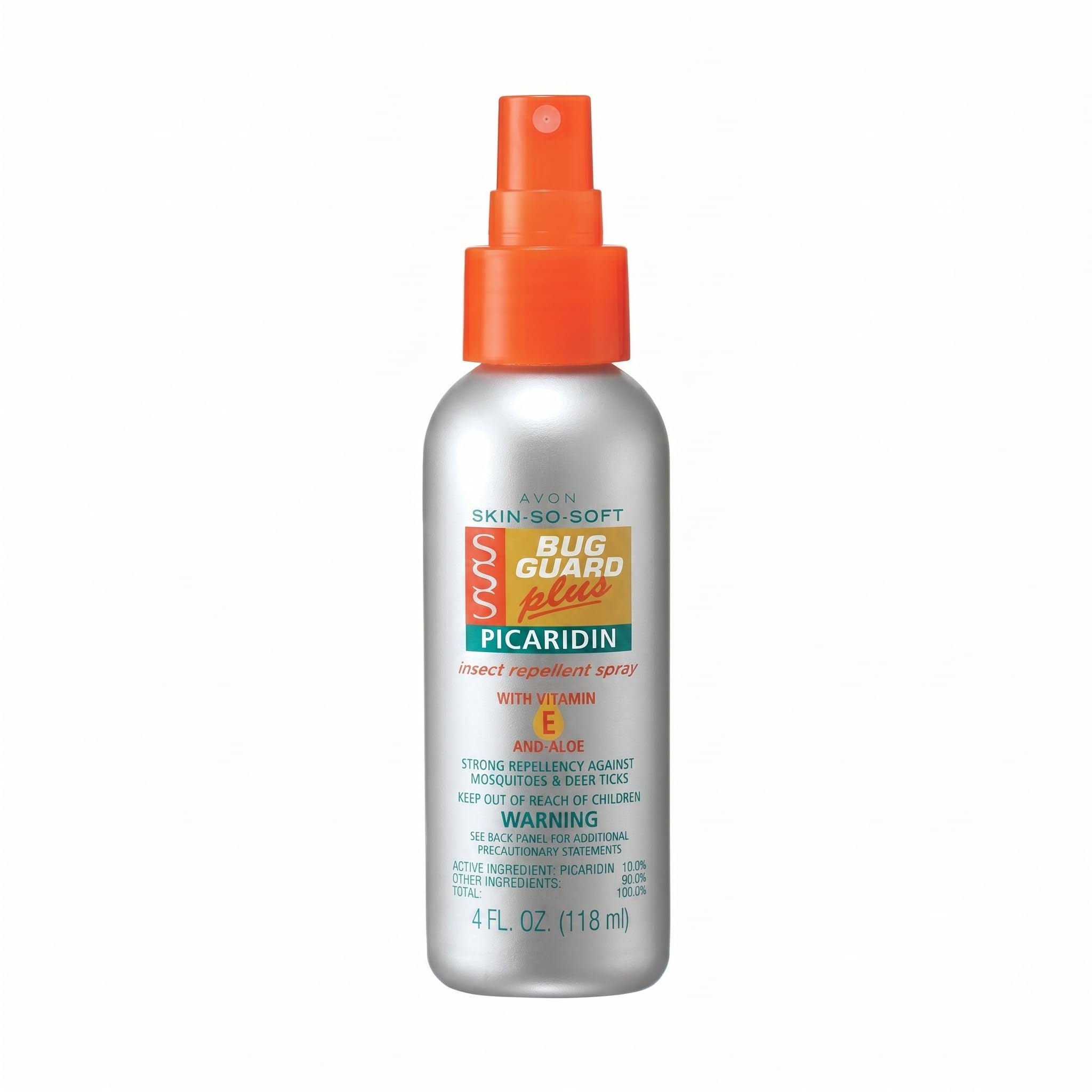
Key Features
- Size: 4 oz
- Also repels: No-see-ums, sand flies, midges
- Protection time: 8 hours (mosquitoes), 12 hours (ticks)
- Active ingredient: Picaridin
- Price: Premium
Four ounces at the top of this group’s price range is a hard sell on paper, and we won’t pretend otherwise. What the money buys is a spray that doesn’t behave like bug spray: low odor, quick to dry, and pleasant enough that a kid doesn’t wipe it off the moment your back is turned.
The numbers hold up — eight hours against mosquitoes, twelve against deer ticks, plus no-see-ums, sand flies and midges, which most formulas here ignore entirely. It’s oil-free and PABA-free, and it disappears into skin rather than sitting on top of it.
Where it wins for us is the bag. A four-ounce bottle is the one that actually goes to the playground, the beach and the glovebox, and a repellent that stays home protects nobody. We’re happy to pay more per ounce for the bottle we’ll carry — just check the sprayer when it arrives, because a missing nozzle makes the whole thing useless.
Pros
- Low-odor formula kids don’t fight
- Eight hours mosquitoes, twelve hours ticks
- Small bottle that travels well
Cons
- Highest price per ounce here
- Sprayer can arrive missing or loose
Worth it if the bottle has to leave the house: a low-odor, fast-drying spray with tick coverage that a kid won’t object to wearing.
What We Put These Kid Bug Sprays Through
We gathered every spray labeled for children that we could find on drugstore shelves and in the usual online listings, then cut anything with vague age guidance or an active ingredient not cleared for use on kids. That left 16 formulas, which we tested over four months. For the botanical ones, we read the entire ingredient list rather than trusting the front of the bottle — plenty of "natural" sprays are mostly alcohol and fragrance.
Then we counted bites. Each tester spent two hours outside at peak mosquito hour without reapplying and logged every new bite at the ankles, wrists, and neckline; that’s how we found that the citronella-only formulas faded well before the eight o’clock bug hour. We tracked how long each formula held before a second coat was needed, smelled each one at application and again on a shirt collar the next morning, and asked three kids between 5 and 11 whether they’d let us spray them again — a spray a child refuses is a spray that never goes on.
Skin came next: a patch behind the knee for 30 minutes, then a close look for redness or complaints. For greasiness, we sprayed a forearm and pressed a tissue against it to see what stuck, then watched whether sand and cut grass clung at the park. We tossed each bottle sideways in a backpack for a week to check for leakage, tested sprayability one-handed and upside-down on a wriggling kid, and counted applications per bottle so we could compare cost per use instead of sticker price.
How to Choose a Bug Spray for Kids
The best repellent for a child is the one you can get onto them, at the right concentration, before they run out the door — protection you can’t apply is protection you don’t have.
Start with the active ingredient
Almost everything here runs on one of three actives: DEET, picaridin, or oil of lemon eucalyptus. Picaridin at 20 percent gives the longest windows in this set, up to 14 hours on the Boogie lotion and 12 on the Sawyer spray, with no smell and nothing that attacks plastics. DEET has the longest track record of the three and the widest spread of concentrations. Oil of lemon eucalyptus is the botanical route and tops out around six hours.
Within each active, concentration sets the clock. A 15 percent DEET formula and a 20 percent picaridin formula are both mid-length products; the deep-woods concentrations run longer and cost more. Decide how long you need to be covered, then buy the smallest concentration that gets you there.
Check the age on the label
Repellent labels carry a minimum age, and that line is the fastest filter when there’s a baby in the house. The OFF! Adults & Kids Lotion states six months and up, which is why it’s where we start a family with an infant. A bottle whose label doesn’t address age at all is a question mark, not a green light.
Below the age a label covers, the answer isn’t a product: a net over the stroller, long sleeves and shade do more than any formula. Read the line before the first application rather than after a bad evening.
Match the format to the child
Aerosols are the fastest thing to use on a cooperative kid and the worst on a moving one. The mist drifts, it’s easy to catch a lungful while you chase, and it settles on whatever is downwind. Lotions give you fingertip control and leave nothing on the car seat, at the cost of a slower job on arms and legs.
Pump sprays sit in between: fine for a school-age child who will hold still, awkward one-handed. If you’re buying for a two-year-old, buy the lotion.
Work out how long you actually need
Protection windows here run from six hours on the botanical pick to fourteen on the top lotion, and that gap changes how you use the bottle. A backyard supper needs very little; a full day at camp needs a formula that claims the day or a second bottle in the backpack.
The trap is treating one morning application as all-day cover. Sweat, water and heat all shorten the window, and a product claiming six hours is telling you it’s a two-application day.
Think in seasons, not bottles
Family use burns through repellent faster than most people expect: a four-ounce can is a matter of weeks in July, so a twin pack isn’t as generous as it looks on the shelf. Compare what a bottle covers rather than what it costs.
A long shelf life, as on the Sawyer twin pack, makes stocking up sensible. A small bottle at a premium price is only a fair trade if it’s the one that actually lives in your bag.
Frequently Asked Questions
Is DEET safe to use on a young child?
It’s the most studied repellent there is, and pediatric guidance treats concentrations of 10 to 30 percent as suitable for children from about two months of age. The 15 percent formula in the OFF! Family Care can sits comfortably inside that range.
Two habits matter more than the percentage: keep it off a child’s hands, and wash it off at the end of the day rather than letting it stay on overnight.
Should repellent go on before or after sunscreen?
Sunscreen first, then a few minutes to let it soak in before the repellent goes on top. Keep them as two separate products rather than buying a combination bottle.
Sunscreen needs reapplying every couple of hours while a 12-hour repellent does not, and a combo pushes you into over-applying the repellent just to top up the sun protection.
Will repellent damage car seats, sunglasses or clothing?
DEET is the one to keep off plastics and synthetic fabrics, where it can cloud a finish or mark a strap. The Sawyer spray is listed as safe on plastics, coatings, sunglasses and outdoor gear.
Spray outdoors rather than in the car, let skin dry before it touches upholstery, and apply repellent before a child gets into the car seat, not after.
Final Verdict
For most families the Boogie lotion is the answer: 20 percent picaridin, up to 14 hours of cover, and a format you can control on a child who won’t stand still. If the printed age line matters more to you — and with a baby it should — the OFF! Adults & Kids Lotion is the only pick here that states one, at six months and up.
For a school-age kid heading out for a whole day, the Sawyer pump’s 12 hours and fragrance-free finish make the fussy sprayer worth putting up with.
